

Online selling has become a practical way for businesses in Bangladesh to reach customers, build visibility, and generate sales. However, choosing the right platform can make a major difference in how easily a business can grow.
For many entrepreneurs, f commerce is the first step into online business. Setting up a Facebook Page is simple, familiar, and requires very little initial investment. Products can be displayed through posts, customers can ask questions through Messenger, and orders can often be managed without building a separate website.
But convenience is only one part of the decision.
As a business grows, depending entirely on Facebook can create challenges related to branding, customer data, order management, automation, and platform control. A dedicated e-commerce website requires more planning and investment, but it gives a business greater control over its online presence and sales process.
This is why the E Commerce vs F Commerce comparison is especially important for growing businesses in Bangladesh. One model can provide a quick and affordable starting point, while the other is designed to support a more structured and scalable online operation.
In this guide, we will look at how both models work, their advantages and limitations, and which situations may be better suited to each approach.
What is F Commerce?
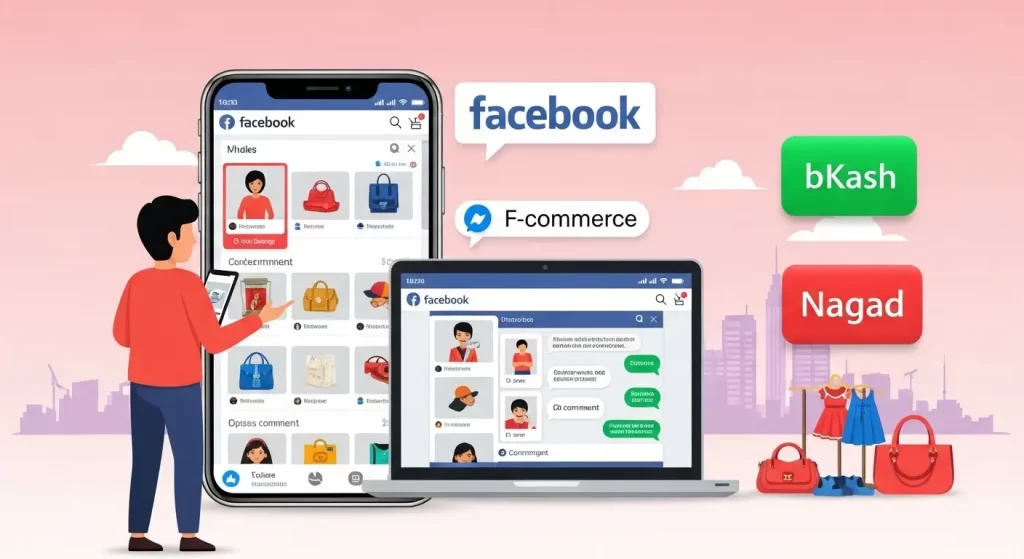
F Commerce refers to selling products or services through Facebook rather than through a dedicated online store. In Bangladesh, businesses commonly use Facebook Pages, Groups, Marketplace, Messenger, and advertising tools to promote products and communicate with customers.
The model is popular because of Facebook’s massive reach in Bangladesh. According to DataReportal 2024, Bangladesh has over 52 million social media users, and Facebook is the most widely used platform in the country. For small businesses, this audience is an immediate customer base without the need for technical setup.
Another reason behind F-commerce growth is low entry cost. Opening a Facebook Page is free. Marketing is often done through organic posts or small-budget boosted ads. For example, many boutique clothing stores in Dhaka spend between 500 to 1,000 BDT per ad campaign, reaching thousands of local users. This creates a quick way to generate sales without investing in a full e-commerce system.
However, the process remains manual. Orders are usually confirmed through Messenger. Payments are handled via Cash on Delivery (COD) or mobile banking apps like bKash and Nagad. Inventory management, invoices, and shipping integration are almost always tracked manually, which makes scaling difficult.
F-commerce in Bangladesh gives small businesses a quick start. It is useful for testing ideas, launching products, or reaching a local community. The limits become clear once a business begins to grow beyond a small customer base.
What is E-commerce?
E-commerce is the process of selling products or services through a dedicated website or mobile application. F-commerce relies on Facebook. An e-commerce store gives businesses their own space, with full ownership and control.
A typical seller may upload product photos, add prices and descriptions, respond to customer questions in comments or Messenger, and manually confirm orders.
How Does F Commerce Work in Bangladesh?
The popularity of f commerce in Bangladesh is closely connected to Facebook’s large and active user base. Small businesses can start reaching potential customers without first investing in a domain, hosting, website development, or a complex online sales system.
The entry barrier is also relatively low. Creating a Facebook Page does not require a major investment, and businesses can initially promote products through regular posts before spending money on paid advertising.
For example, a small clothing, cosmetics, handmade product, or home-based food business can publish its products on Facebook and begin receiving enquiries almost immediately. This makes Facebook particularly useful for testing product demand before making a larger investment.
However, much of the sales process is often manual. Customers may place orders through Messenger, while businesses record names, phone numbers, addresses, product details, and delivery information separately. Payments may be collected through Cash on Delivery or mobile financial services such as bKash and Nagad.
This approach can work well when order volume is manageable. As sales increase, manually tracking inventory, customer information, invoices, deliveries, and order status can become more difficult.
For this reason, f commerce can be a practical starting point for new or small businesses, but growing businesses may eventually need a more organized sales infrastructure.
What Is E-commerce?
E-commerce refers to selling products or services through a dedicated website, online store, or application. Instead of relying completely on a third-party social platform, the business operates through a digital property built specifically for browsing, ordering, payment, and customer management.
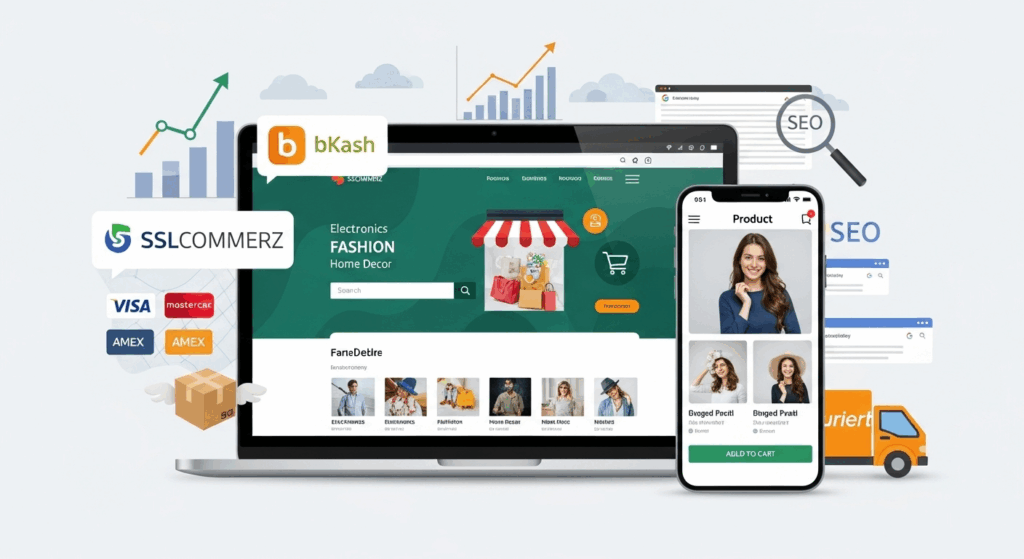
An e-commerce website can include product categories, search and filtering options, shopping carts, checkout systems, customer accounts, payment gateways, order tracking, inventory management, and integrations with delivery services.
How Is E-commerce Different from f commerce?
The biggest difference is control.
With f commerce, businesses operate within Facebook’s platform and its rules. An e-commerce website gives the business significantly more control over its brand presentation, customer journey, website structure, product information, analytics, and sales process.
Setting up an e-commerce store usually requires investment in a domain name, hosting, website design, development, security, maintenance, and payment integration. Businesses in Bangladesh may also integrate payment options such as cards, mobile financial services, and local payment gateways while connecting courier services to streamline delivery.
Although the initial setup is more involved, many repetitive tasks can be automated. Customers can browse products, add items to a cart, complete checkout, receive order confirmations, and track purchases without requiring a business owner to manually manage every step through Messenger.
Another important advantage is search visibility. A properly structured e-commerce website can be optimized for Google, allowing potential customers to discover products while actively searching for them. A focused eCommerce SEO strategy can further improve product pages, category pages, technical structure, and organic visibility. This gives businesses an additional customer acquisition channel beyond social media.
E-commerce is therefore particularly useful for businesses that want to build a recognizable brand, manage larger product inventories, automate their sales process, and create a digital platform they can develop over the long term.
E Commerce vs F Commerce: Head-to-Head Comparison
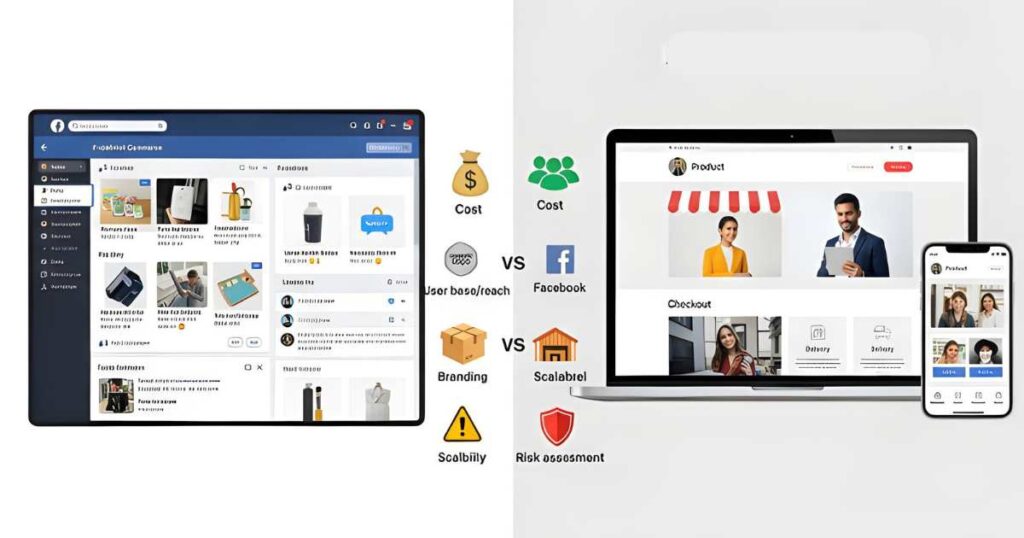
Business owners in Bangladesh often struggle to decide between staying on Facebook or moving to a dedicated website. The differences become clear when we look at the core factors side by side.
| Factor | F Commerce Facebook-Based |
E Commerce Website-Based |
|---|---|---|
| Setup Cost | Low-cost to start. Creating a Facebook Page is free, while paid promotion can begin with a small advertising budget. | Requires investment in a domain, hosting, website design, development, and maintenance. |
| Customer Reach | Reach potential customers through Facebook Pages, Groups, Marketplace, organic posts, and paid ads. | Reach customers through Google Search, direct visits, SEO, paid search, email marketing, and other digital channels. |
| Branding Control | Brand presentation is limited by Facebook’s layout, features, and platform rules. | Full control over website design, brand identity, product presentation, and customer experience. |
| Order Process | Orders are commonly handled manually through Messenger, comments, phone calls, or WhatsApp. | Customers can browse products, add items to a cart, complete checkout, and receive automated confirmation. |
| Payment Options | Often relies on Cash on Delivery, bKash, Nagad, or manually confirmed payments. | Can integrate payment gateways, cards, mobile financial services, Cash on Delivery, and automated payment confirmation. |
| Inventory Management | Stock and product availability are often tracked manually, which becomes difficult as order volume grows. | Inventory can be managed through structured systems with stock updates, product variations, and reporting. |
| Scalability | Suitable for smaller operations, but managing a large number of products and orders can become challenging. | Better suited for growing businesses with larger catalogs, higher order volumes, and more complex operations. |
| SEO Potential | Limited organic search visibility because most content remains inside Facebook’s ecosystem. | Products, categories, and content can be optimized for Google and generate long-term organic traffic. |
| Customer Data | Access to customer data is limited by Facebook’s platform and available communication tools. | Businesses can collect and analyze customer, traffic, order, and conversion data through their own systems. |
| Platform Dependency | Highly dependent on Facebook policies, algorithms, account status, and platform changes. | Provides greater control over the business platform, while hosting, security, and maintenance remain manageable responsibilities. |
Key Insight: F Commerce is best for starting small and reaching customers quickly, but it lacks control and scalability. E-commerce requires investment, yet it builds long-term stability, brand trust, and room for growth.
F Commerce or E Commerce: Which Fits Small Businesses in Bangladesh?
For a small business in Bangladesh, choosing between Facebook selling and a dedicated online store depends mainly on the stage of the business, available budget, order volume, and long-term goals.
Facebook offers an easy starting point because customers are already familiar with browsing products, messaging sellers, and interacting with business pages. According to DataReportal’s Digital 2026 report, Meta’s advertising tools indicated a potential Facebook advertising audience of around 64 million people in Bangladesh in late 2025. This shows why Facebook continues to be an important channel for online businesses.
For a new entrepreneur with a limited product range, F Commerce can therefore be a practical way to test demand, communicate directly with customers, and start selling without investing immediately in a complete website.
However, the process becomes more difficult as order volume increases. Responding to every message, confirming orders manually, checking stock, collecting customer information, and coordinating deliveries can take considerable time.
This is where the E Commerce vs F Commerce decision becomes more important. A dedicated website can organize products, automate checkout, integrate payments, track orders, and give customers a consistent shopping experience without requiring every sale to be handled through a conversation.
The two channels do not necessarily have to compete. A growing business can use Facebook for discovery, content, community building, and advertising while using its website as the main platform for product information, checkout, payments, and order management. Comparing Facebook vs Google Ads can also help businesses decide which paid channel better fits their audience and buying intent.
How Bangladeshi Businesses Use E Commerce Platforms
Large online businesses in Bangladesh demonstrate how an organized digital platform can support a much broader customer journey than social media alone.
Aarong, for example, maintains an online store alongside its physical retail presence and social media activity. Customers can browse products through its website, manage their shopping cart, and access online purchasing options without depending entirely on Facebook communication.
Chaldal provides another example of a website-centered online shopping experience. Customers can search grocery and household products, add items to a cart, choose a delivery location, and complete an order through a structured digital system. Its service currently covers multiple major urban areas in Bangladesh.
Daraz Bangladesh also uses social platforms for marketing while operating a dedicated marketplace where customers can search products, compare options, place orders, choose among available payment methods, and manage purchases.
These businesses are much larger than a typical small Facebook seller, so their business models should not be compared directly. However, they demonstrate an important principle: as online operations become more complex, a structured website or application can handle processes that become difficult to manage manually.
For a smaller business, the same principle can be applied gradually. Facebook can continue generating awareness while the website becomes the business’s controlled destination for products and transactions.
Actionable Steps for Bangladeshi Entrepreneurs
Moving from social selling to an e-commerce website does not need to happen overnight. Businesses can make the transition gradually based on actual needs rather than building an expensive platform before there is enough demand. If you are planning that transition, our guide on how to start an ecommerce business covers the main steps from planning and platform selection to payments, marketing, and growth.
When Should You Move Beyond F Commerce?
Consider building an e-commerce website when Messenger-based order management starts taking too much time, your product catalog becomes difficult to organize, or customers frequently ask whether your business has an official website.
Other useful signs include:
- Your weekly order volume is steadily increasing.
- Stock management is becoming difficult manually.
- Customers need an easier way to browse products.
- You want customers to order outside normal business hours.
- You want to generate traffic from Google Search.
- Your business needs automated order confirmation.
- You want better control over customer experience and branding.
- You are spending consistently on Facebook advertising and want to direct that traffic to a platform you control.
There is no fixed number of orders that automatically means a business needs a website. A company selling five high-value products may have different requirements from another business processing hundreds of inexpensive orders each week.
Estimate Your E Commerce Budget
The cost of developing an e-commerce website in Bangladesh depends on the size and complexity of the project.
Typical expenses may include:
- Domain registration
- Web hosting
- Website design and development
- Product uploading
- Payment gateway integration
- Courier or delivery integration
- Website security
- Maintenance and technical support
- SEO and analytics setup
A simple WooCommerce store will usually require a different budget from a custom e-commerce platform with advanced inventory management, customer accounts, ERP integrations, or specialized checkout requirements.
Instead of selecting a website only by the lowest development price, businesses should consider what functionality they actually need and how easily the platform can be maintained as sales grow.
Plan the Website Before Development
A clear project scope can make development faster and prevent unnecessary revisions.
Before development begins, decide:
- What products will be sold?
- How many products and categories are required?
- Will customers need accounts?
- Which payment methods will be available?
- Will Cash on Delivery be offered?
- Which locations can the business deliver to?
- Will stock be updated automatically?
- Does the website need coupon or discount functionality?
- What information should customers receive after ordering?
The development timeline will depend on these requirements. A straightforward online store can usually be completed more quickly than a custom platform requiring complex integrations.
Prepare Your Business Assets
Having the necessary content ready before development can also make the process smoother.
Prepare:
- Business name and logo
- Brand colors and fonts
- High-quality product images
- Product names and descriptions
- Prices and variations
- Size or measurement information
- Delivery information
- Payment methods
- Return and refund policy
- Contact details
- Privacy policy and terms
Clear product information is particularly important because customers cannot physically inspect products before purchasing them online.
Keep Facebook Active After Launching Your Website
Launching an e-commerce website does not mean closing your Facebook Page.
Instead, use the two channels for different parts of the customer journey.
Facebook can help with:
- Brand awareness
- Product announcements
- Customer engagement
- Retargeting
- Paid advertising
- Community building
Your website can then handle:
- Product browsing
- Detailed information
- Checkout
- Payments
- Order confirmation
- Customer data
- Analytics
- Organic search traffic
This approach allows businesses to benefit from Facebook’s audience while gradually reducing dependence on a single third-party platform.
Final Thoughts on F Commerce and E Commerce
F Commerce has lowered the barrier to online selling for businesses across Bangladesh. It provides a simple way for entrepreneurs to present products, communicate with customers, and test whether there is demand for what they sell.
A dedicated e-commerce website solves a different set of problems. It provides greater control over product presentation, checkout, customer experience, analytics, SEO, and business processes.
For many growing businesses, the most practical strategy is therefore not to abandon Facebook. Instead, Facebook can continue working as an audience and marketing channel while the website becomes the central platform for the brand and its online sales.
If your business has reached the point where manual orders are becoming difficult to manage, Okriya can help you build a structured online store. Our E Commerce Development Services are designed around your products, customer journey, payment requirements, and future growth plans.
The goal is simple: turn social media attention into an online sales system your business can control.
FAQs About F Commerce and E Commerce
What Is the Difference Between E Commerce and F Commerce?
F Commerce means selling through Facebook using tools such as Pages, Groups, Marketplace, and Messenger. E-commerce uses a dedicated website or application where customers can browse products and complete purchases through a structured checkout system.
Facebook selling generally has a lower barrier to entry, while an e-commerce website provides greater control over branding, product organization, checkout, analytics, and automation.
Why Is Cash on Delivery Popular in Bangladesh?
Cash on Delivery allows customers to pay when an order reaches them rather than paying in advance. It remains an important payment option for online businesses, particularly for customers who are more comfortable paying after receiving a delivery.
Businesses can also provide digital payment options such as mobile financial services, cards, and payment gateways so customers can choose the method they prefer.
How Much Does an E Commerce Website Cost in Bangladesh?
There is no single fixed price. The cost depends on the number of products, design requirements, platform, payment integration, delivery integration, custom functionality, security, maintenance, and other technical requirements.
A basic WooCommerce website can cost considerably less than a custom-built e-commerce platform with advanced inventory, ERP, mobile application, or automation requirements.
Businesses should therefore request a quotation based on their actual requirements rather than selecting a platform based only on a generic starting price.
What Are the Main Challenges of Selling Through Facebook?
Common challenges include:
- Manual order management
- Limited website-style customization
- Dependence on Facebook policies and algorithms
- Difficulty organizing large product catalogs
- Limited control over the complete customer journey
- Difficulty integrating advanced inventory and business systems
- Dependence on messaging for many customer interactions
These limitations may have little impact on a very small seller but become more noticeable as the business grows.
Can Facebook and E Commerce Be Used Together?
Yes. In fact, they can complement each other effectively.
A business can publish content and run advertising campaigns on Facebook, then send interested customers to its website to review products and complete purchases. This allows Facebook to work as a marketing channel while the website works as the business’s primary digital sales platform.
How Does Delivery Work for E Commerce Businesses in Bangladesh?
Businesses can manage deliveries themselves or work with third-party courier and logistics providers. Depending on the provider and integration available, businesses may be able to arrange pickups, nationwide delivery, Cash on Delivery, delivery tracking, and order-status updates.
The right logistics setup depends on product type, delivery area, order volume, and customer expectations.
Is E Commerce Suitable for Long-Term Business Growth?
A dedicated online store provides tools that become increasingly useful as a business grows, including product organization, automated checkout, inventory management, analytics, SEO, customer accounts, and integration with other business systems.
Facebook can still remain an important marketing channel, but the website gives a business greater control over its digital infrastructure.
Are There E Commerce Rules in Bangladesh?
Yes. Businesses operating online in Bangladesh should be aware of applicable consumer protection requirements and the government’s Digital Commerce Operation Guidelines 2021.
An online store should clearly communicate important information such as business identity, product details, pricing, payment terms, delivery conditions, refund or return policies, privacy practices, and customer support information where applicable.
Businesses should review the latest government requirements or obtain professional advice when compliance requirements apply to their specific operation.
Does an E Commerce Website Need SEO?
Yes, if the business wants potential customers to discover its website through search engines.
SEO can help product pages, category pages, and useful informational content appear when people search for relevant products or services. For businesses serving specific areas in Bangladesh, a local SEO strategy can also improve visibility for location-based searches and nearby customers. Unlike paid advertising, organic search visibility can continue attracting visitors without paying for every click.
For many businesses, SEO and social media advertising work best as complementary channels rather than replacements for one another.