
Paid advertising can help businesses reach customers faster than relying only on organic marketing. But when companies first start investing in digital advertising, one question comes up again and again: should the budget go to Facebook or Google?
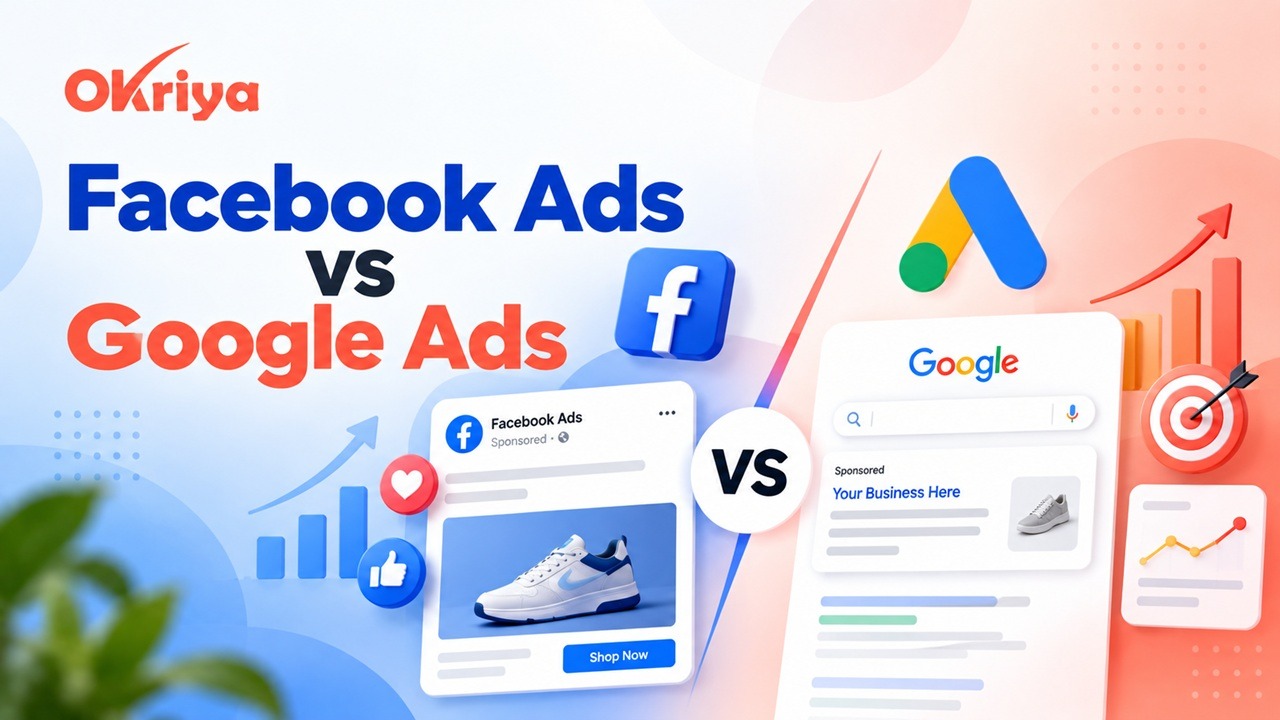
The Facebook vs Google Ads comparison is not simply about finding one platform that is better than the other. The two advertising systems often reach customers at different moments in the buying journey.
Google Ads is particularly useful when someone is actively searching for a product, service, solution, or business. Facebook Ads, managed through Meta’s advertising ecosystem, can help businesses introduce products and offers while people are browsing Facebook, Instagram, Reels, and other placements.
Understanding Facebook vs Google Ads therefore starts with understanding customer intent.
This guide compares how the two platforms work, their targeting approaches, campaign goals, costs, ecommerce opportunities, lead generation potential, and situations where using both can create a stronger advertising strategy.
Facebook vs Google Ads: Understanding the Basic Difference
The biggest difference between the two platforms is how customers discover advertisements.
Google often connects businesses with people who are already searching.
Imagine someone searches:
“emergency plumber near me”
“best accounting software for small business”
“web development company”
“buy running shoes online”
Those searches indicate some level of existing demand. Google Ads gives advertisers an opportunity to appear while that demand is being expressed.
Facebook works differently.
People generally do not open Facebook or Instagram specifically to search for a plumber, ecommerce product, or software provider. They browse content, watch videos, communicate with people, and discover brands along the way.
Advertisers can introduce products or services based on audiences, behavior signals, previous interactions, creative performance, and Meta’s delivery systems.
This difference is central to the Facebook vs Google Ads discussion.
A simple way to think about it is:
Google Ads can capture existing demand.
Facebook Ads can help create and influence demand.
However, modern advertising platforms are becoming more sophisticated, so the distinction is not always absolute. Google also provides discovery-oriented advertising opportunities, while Meta can generate conversions from people already familiar with a brand.
Facebook ads vs Google ads: Key Differences
When comparing Facebook ads vs Google ads, marketers should look beyond traffic volume.
The right platform depends on the type of customer you need to reach and what action you want that customer to take.
| Factor | Google Ads | Facebook Ads |
|---|---|---|
| Main Strength | Capturing search intent | Audience discovery and demand generation |
| User Behavior | Often actively searching | Often browsing content |
| Targeting Focus | Keywords, intent, audiences and signals | Audiences, interests, behaviors and platform signals |
| Creative Importance | Important | Extremely important |
| Strong Formats | Search, Shopping, video, display | Images, videos, Stories, Reels, carousel |
| Good For | High-intent leads and sales | Awareness, discovery, leads and ecommerce |
| Customer Journey | Often middle or lower funnel | Often upper, middle and lower funnel |
| Remarketing | Available | Available |
| Learning Curve | Keyword and campaign structure focused | Creative and audience testing focused |
This table provides a general overview rather than a rule for every campaign. A business selling visually attractive consumer products may perform extremely well with Facebook and Instagram advertising.
Meanwhile, a company offering emergency services may benefit more from Google because customers are likely to search when they immediately need the service. That is why the Facebook ads vs Google Ads decision should start with customer behavior rather than assumptions about which platform is cheaper.
How Google Ads Works
Google Ads allows businesses to advertise across Google’s advertising ecosystem.
Search advertising is one of its best-known formats. Advertisers can target searches related to their products or services and compete for visibility when relevant queries occur.
For example, a software development company might advertise around searches such as:
- Mobile app development company
- Ecommerce website development
- Custom software development
- Web development services
- Hire app developers
Someone searching these terms may already be researching providers.
Google also offers other campaign types and advertising environments beyond traditional Search, allowing businesses to reach audiences through video, shopping experiences, websites, apps, and other Google properties.
The important advantage is access to intent signals.
When users clearly describe what they want through a search query, advertisers have valuable information about their needs.
When Google Ads Makes Sense
Google Ads can be particularly useful when:
- Customers actively search for your service
- Your business solves an urgent problem
- You sell products with existing search demand
- You generate leads through a website
- Search keywords show strong commercial intent
- You want to reach customers close to making a decision
For example, a person searching for “air conditioning repair near me” is probably much closer to becoming a customer than someone casually watching home improvement videos.
That high level of intent can make Google Ads valuable for service businesses.
How Facebook Ads Work
Facebook Ads are part of Meta’s advertising platform and can reach users across placements such as Facebook and Instagram.
Instead of relying primarily on keywords people type into a search box, advertisers can reach potential customers through audience signals and Meta’s advertising delivery technology.
The platform is particularly strong for visual storytelling.
Brands can use:
- Image ads
- Video ads
- Reels
- Stories
- Carousel ads
- Product-focused campaigns
- Lead generation campaigns
- Remarketing campaigns
Businesses can show potential customers products they may not have previously considered purchasing.
For example, someone may not search Google for a specific handmade home decoration product.
But an attractive Facebook or Instagram video could introduce that product and generate interest immediately.
Why Creative Matters So Much
People scroll quickly through social feeds.
Your advertisement competes with videos, photos, creators, friends, businesses, entertainment, and other advertising.
That means the creative needs to earn attention.
Strong Facebook advertising often combines:
- An effective opening hook
- Clear visuals
- A relevant customer problem
- Product benefits
- Social proof
- A compelling offer
- A simple call to action
Testing several creative variations can help businesses identify which messages and formats connect with customers.
Facebook vs Google Ads for Customer Intent
Customer intent is one of the most important differences between these platforms.
Suppose someone needs a lawyer.
They may immediately search Google for something like:
“business lawyer near me.”
That search creates an opportunity for law firms advertising around relevant keywords.
Now imagine a clothing brand launching a new collection.
Potential customers may not know that collection exists, so they cannot search for it yet.
A Facebook or Instagram advertisement can introduce the collection while those customers browse social media.
This is why a Facebook vs Google Ads strategy should consider whether your business needs to capture demand or generate it.
Many businesses need both.
Social advertising can introduce a brand, while search advertising can capture customers later when they actively research products or services. Building a stronger brand presence in Google SERPs can also reinforce trust when those users later search for your business.
Facebook ads vs Google ads for Lead Generation
Facebook ads vs Google ads: Lead Quality and Intent
Lead generation works differently across the two platforms.
Google Search campaigns can attract users who are deliberately looking for a solution. This can produce leads with strong immediate intent when the right keywords, landing pages, and conversion tracking are used.
Facebook can generate leads earlier in the buying journey.
For example, a real estate company could advertise a property guide, consultation, or project offer to relevant audiences. A user might submit information even though they were not actively searching at that moment.
When comparing facebook ads vs google ads for leads, businesses should measure more than cost per lead.
A cheap lead is not necessarily a valuable lead.
Important metrics include:
- Qualified lead rate
- Appointment rate
- Sales conversion rate
- Cost per qualified lead
- Customer acquisition cost
- Revenue generated
- Return on advertising spend
If Campaign A generates 100 cheap leads but only two customers, it may be less valuable than Campaign B generating 30 more expensive leads that produce ten customers.
Facebook vs Google Ads for Ecommerce
Facebook vs Google Ads for Online Stores
Ecommerce businesses often have opportunities on both platforms.
Google can be effective when shoppers already know what they want.
Someone searching for:
“men’s leather wallet”
“wireless gaming mouse”
“running shoes for women”
“buy office chair online”
is demonstrating product interest.
Social advertising can influence buyers differently.
A customer might discover a new fashion brand through a Reel, see the product again through remarketing, visit the website later, and eventually purchase.
For ecommerce brands, the Facebook vs Google Ads decision therefore does not always need to be either/or. A well-built eCommerce website can support both platforms by giving paid traffic a fast, mobile-friendly, and conversion-focused shopping experience.
Google may capture active product searches while Facebook and Instagram generate discovery, demonstrate products visually, build familiarity, and bring previous visitors back.
Businesses should evaluate the entire customer journey instead of assigning every sale only to the last advertisement clicked.
Google Ads versus Facebook Ads: Targeting Differences
Another important consideration in Google Ads versus Facebook Ads is how advertisers reach audiences.
Google Search campaigns can use keyword-driven intent. Advertisers can choose searches related to products, services, and customer problems.
Google campaigns can also use audience signals and automated systems depending on the campaign type.
Meta advertising traditionally places greater emphasis on audience discovery and advertising delivery based on user and campaign signals.
Advertisers can also work with first-party audience data where appropriate, create remarketing audiences, and allow automated systems to identify people likely to complete the campaign objective.
Neither approach removes the need for good strategy.
Accurate conversion tracking, strong offers, good landing pages, and relevant creative remain important regardless of platform.
Facebook vs Google Ads Cost: Which Is Cheaper?
There is no universal answer.
Advertising costs depend on factors such as:
- Industry
- Country
- Competition
- Audience
- Keywords
- Campaign objective
- Product price
- Seasonality
- Ad quality
- Creative performance
- Landing page experience
A highly competitive Google keyword may have an expensive cost per click.
Facebook may sometimes generate cheaper traffic, but cheaper clicks do not automatically mean cheaper customers.
The correct way to compare Facebook vs Google Ads cost is through business outcomes.
Instead of asking:
“Which platform gives me cheaper clicks?”
Ask:
“Which platform generates profitable customers?”
Important numbers include customer acquisition cost, conversion rate, cost per qualified lead, revenue, profit margin, and return on ad spend.
google ads versus facebook ads for Small Businesses
google ads versus facebook ads: Which Fits Your Goal?
Small businesses usually have limited advertising budgets, making campaign selection especially important.
When considering Google Ads versus Facebook Ads, start with the business model.
A local repair company, legal service, dental clinic, web development agency, or emergency service may find significant value in search advertising because customers actively look for those services.
A clothing brand, beauty company, restaurant, lifestyle product, home decor business, or new consumer brand may benefit from visual social advertising that helps people discover products.
However, there are many exceptions.
The platform should follow the customer journey.
Before spending money, answer these questions:
- Do people actively search for what we sell?
- Is our product visually attractive?
- Do customers purchase immediately or research first?
- What is our average customer value?
- What action should happen after someone clicks?
- Can we track that action accurately?
The answers can help determine where your first advertising tests should focus.
Remarketing on Facebook and Google
Most customers do not purchase during their first interaction with a brand.
Remarketing allows businesses to continue communicating with people who have previously interacted with their website, products, or marketing.
Imagine someone visits an ecommerce product page but leaves without buying.
Later, an advertising campaign may bring that user back.
Remarketing becomes especially powerful when different channels work together.
For example:
A customer discovers a business through Facebook.
They visit the website.
Several days later, they search Google for the product.
They compare alternatives.
They return to the website and purchase.
This journey shows why evaluating advertising platforms in isolation can sometimes produce an incomplete picture.
Landing Pages Matter on Both Platforms
Even excellent advertising cannot permanently compensate for a weak website.
When someone clicks an advertisement, the landing page should continue the same message and make the next action obvious.
A strong landing page should usually provide:
- A clear headline
- Relevant information
- Strong product or service benefits
- Trust signals
- Easy navigation
- Fast loading
- Mobile-friendly design
- Clear calls to action
If an advertisement promises a specific service but directs visitors to a generic homepage, conversion rates may suffer.
The same applies to ecommerce advertising.
If users click an advertisement for a particular product, directing them immediately to that product is usually more useful than sending them to a broad store homepage.
Conversion Tracking Is Essential
Running ads without reliable tracking makes optimization difficult.
Businesses need to understand which campaigns generate valuable actions.
Depending on the business, conversions may include:
- Purchases
- Phone calls
- Contact forms
- Quote requests
- Bookings
- Account registrations
- App installs
- Qualified leads
Tracking should connect advertising activity with actual business results whenever possible.
Do not judge campaigns only by impressions, reach, clicks, or engagement.
Those metrics can be useful, but they do not always represent revenue.
Common Mistakes Businesses Make with Paid Ads
One common mistake is launching campaigns without defining the goal.
Another is changing campaigns too quickly before enough useful data has been collected.
Businesses also frequently send every advertisement to the homepage rather than building relevant landing pages.
Other common problems include:
- Weak conversion tracking
- Poor mobile landing pages
- Using only one creative
- Ignoring search intent
- Broad targeting without strategy
- Focusing only on click costs
- Failing to test offers
- Ignoring lead quality
- Stopping remarketing too early
- Scaling campaigns before confirming profitability
Good paid advertising requires continuous testing and improvement rather than a one-time campaign setup. A broader digital marketing strategy can help connect paid advertising with SEO, content, social media, remarketing, and conversion optimization.
Should You Use Facebook and Google Ads Together?
For many businesses, using both platforms can make sense when the budget supports it.
A simple multi-channel strategy might look like this:
Step 1: Facebook and Instagram introduce the brand through engaging creative.
Step 2: Interested users visit the website and learn about the product.
Step 3: Remarketing keeps the brand visible.
Step 4: Users later search Google for the brand, product, or solution.
Step 5: Search advertising helps capture that high-intent demand.
The exact journey will vary between customers, but the example demonstrates how different platforms can support different stages of a purchase.
Rather than asking which advertising platform should completely replace the other, marketers can ask how each channel contributes to customer acquisition.
Facebook vs Google Ads: Which One Should You Start With?
The best starting platform depends on how customers discover your product or service.
Start by considering Google Ads when:
- Customers actively search for your service
- Search intent is clear
- Your offer solves an immediate need
- You have commercially relevant keywords
- Your landing page is designed for conversion
Consider Facebook Ads when:
- Your product benefits from visual presentation
- Customers may not know they need the product yet
- Video and social creative are important to your sales process
- You want to build awareness while generating leads or sales
- Your product has strong discovery potential
The Facebook vs Google Ads decision should ultimately come from testing real campaign performance.
Even businesses in the same industry can see different results because their offers, pricing, websites, creative, locations, customer profiles, and sales processes are different.
Final Thoughts
The Facebook vs Google Ads comparison is really a comparison between different ways of reaching potential customers.
Google Ads can be particularly powerful when users already demonstrate intent through search. Facebook Ads can help businesses introduce offers, generate demand, visually demonstrate products, and reach potential buyers as they consume social content.
When evaluating Facebook Ads vs Google Ads, avoid focusing only on clicks or impressions. Measure qualified leads, customer acquisition costs, sales, profitability, and long-term customer value.
Similarly, the Google Ads versus Facebook Ads decision does not always require choosing only one platform. When both channels are appropriate, they can support different stages of the same customer journey.
Start with your customer, define a measurable objective, build strong landing pages and creative, track conversions correctly, and let real campaign data determine where your advertising budget creates the most value.