

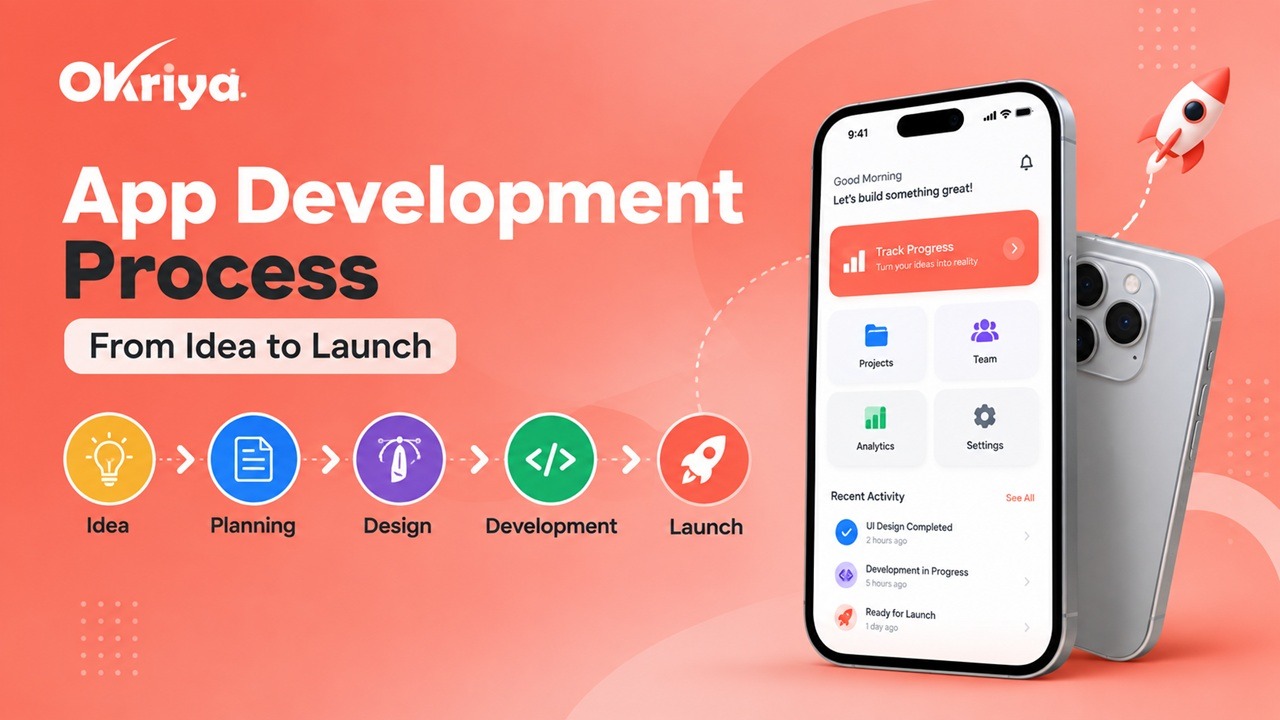
Building a mobile application involves much more than writing code and publishing it to an app store. A successful app starts with a clear idea, moves through careful planning and design, and continues with development, testing, deployment, and ongoing improvements.
Understanding the App Development Process helps businesses avoid unnecessary costs, reduce development risks, and create applications that solve real user problems. Whether you are building an e-commerce app, booking platform, business application, or custom digital product, following a structured process makes development easier to manage.
The mobile app development process also helps developers, designers, project managers, and business owners stay aligned throughout the project. Working with an experienced mobile app development company can also help keep planning, design, development, testing, and launch properly coordinated. Each stage has a specific purpose and contributes to the quality of the final application.
In this guide, we will explain how the complete process works from the initial idea to long-term app maintenance.
App Development Process: Why a Structured Approach Matters
Developing an application without proper planning can quickly become complicated. Features may change frequently, budgets can increase, deadlines may be missed, and the final product may fail to meet user expectations.
A structured App Development Process creates a clear roadmap for the entire project. Before development begins, the team understands what needs to be built, who the target users are, which technologies will be used, and how the application should function.
This approach also improves communication between developers, designers, stakeholders, and clients. Instead of making major decisions during development, important requirements are discussed earlier.
Following an organized mobile app development process can therefore reduce technical problems and help businesses launch a more reliable product.
1. Define the App Idea and Business Goals
Every application begins with an idea, but an idea alone is not enough. The first step is understanding the problem the application will solve.
Businesses should ask several important questions:
- What problem will the app solve?
- Who will use the application?
- Why would users choose this app?
- What business goal should the app support?
- What are the essential features?
- How could the application generate value or revenue?
For example, a restaurant application may help customers order food more conveniently, while a healthcare application may allow patients to schedule appointments.
At this point in the App Development Process, the objective is not to define every technical detail. The goal is to establish a clear direction for the product.
2. Conduct Market and Competitor Research
Once the idea is clear, the next step is research.
Before investing in development, businesses should understand the market and examine similar applications. Competitor research can reveal useful information about features, user expectations, pricing models, and common customer complaints.
Look at competing apps and analyze:
- Core features
- App design
- User reviews
- Pricing models
- Download experience
- Customer complaints
- Unique selling points
User reviews are particularly helpful because they show what customers like and dislike about existing applications.
Research makes the App Development Process more practical because product decisions are based on real market information rather than assumptions.
3. Identify the Target Audience
A successful application needs to be designed for specific users.
Understanding the target audience affects almost every part of the mobile app development process, including navigation, features, design, content, and technology choices.
Businesses should consider factors such as user age, location, devices, interests, problems, and digital behavior.
For example, an app designed for corporate professionals may require a very different interface from an entertainment app targeting teenagers.
Creating simple user personas can help the development team understand who they are building the application for and what users expect from it.
4. Define Features and Requirements
After understanding the market and audience, the next stage is deciding exactly what the application needs to do.
A common mistake is trying to include too many features in the first release. This can increase both development time and cost.
Instead, businesses can begin with an MVP, or Minimum Viable Product.
An MVP contains the most important features required for users to receive value from the application.
For example, a delivery app might initially include:
- User registration
- Product or restaurant listings
- Search
- Cart
- Online ordering
- Payment options
- Order tracking
- Notifications
Advanced features can be introduced later based on user feedback.
Clearly defining requirements at this stage makes the App Development Process easier to estimate, manage, and execute.
5. Plan the Application Structure
Before designing the visual interface, the development team needs to decide how users will move through the application.
This usually involves creating user flows, information architecture, and sometimes basic diagrams showing the relationship between different screens.
For example:
Home → Product → Cart → Checkout → Payment → Confirmation
Planning these journeys early helps identify unnecessary steps and usability problems before development begins.
A simple structure usually creates a better user experience than an application with complicated navigation.
6. Create Wireframes
Wireframes are basic visual layouts that show where important elements will appear on each screen.
They usually focus on structure rather than colors or detailed visual styling.
Wireframes may show:
- Navigation menus
- Buttons
- Forms
- Images
- Search fields
- Content sections
- Product cards
- User profiles
Wireframing is an important part of the App Development Process because changing a wireframe is much faster and less expensive than rebuilding a completed application screen.
It also gives stakeholders an opportunity to review the user journey before visual design begins.
7. Design the UI and UX
Once the wireframes are approved, designers can create the actual user interface.
UI design focuses on how the application looks, while UX design focuses on how easily users can complete tasks.
Designers usually work on elements such as:
- Color schemes
- Typography
- Buttons
- Icons
- Forms
- Navigation
- Spacing
- Images
- Animations
- Interactive components
A good interface should be visually appealing without making the application difficult to use.
During this stage of the mobile app development process, designers may also create interactive prototypes that allow stakeholders to experience how the application will behave before coding begins.
8. Choose the Right Technology Stack
Technology selection can significantly affect performance, development cost, scalability, and future maintenance.
The appropriate technology depends on the project’s requirements.
App Development Process: Native, Cross-Platform, or Hybrid Development
One important decision in the App Development Process is choosing how the mobile application will be developed.
Native development creates separate applications specifically for platforms such as Android and iOS. Native applications can provide excellent performance and deeper access to device features.
Cross-platform development allows developers to create applications for multiple platforms using a shared codebase. Technologies such as Flutter and React Native are commonly used for this approach.
Hybrid applications combine web technologies with native app containers and may be suitable for certain business requirements. Businesses comparing app technologies can also explore Progressive Web Apps for Business to understand when a web-based, app-like experience may be a practical alternative.
The best option depends on the project’s budget, features, timeline, performance requirements, and long-term plans.
9. Start Frontend and Backend Development
After the design and technical architecture are finalized, developers begin building the application.
Frontend development focuses on everything users directly interact with, including screens, buttons, forms, menus, and animations.
Backend development manages the systems behind the application. For projects with complex workflows, APIs, integrations, or business logic, a broader software development approach may also be required. This may include:
- Databases
- APIs
- User authentication
- Payment processing
- Notifications
- Business logic
- Admin dashboards
- Third-party integrations
For larger projects, frontend and backend development often happen simultaneously.
A well-organized App Development Process keeps both sides properly coordinated so that the interface communicates correctly with backend services.
10. Test the Application
Testing is one of the most important stages of application development.
Even a well-designed app can create a poor user experience if it contains crashes, broken features, security problems, or performance issues.
Testing may include:
Functional testing: Checks whether features work correctly.
Usability testing: Evaluates whether users can easily navigate the application.
Performance testing: Measures loading speed, responsiveness, and stability.
Compatibility testing: Checks the application across different devices, screen sizes, and operating system versions.
Security testing: Identifies potential vulnerabilities and protects sensitive information.
Regression testing: Ensures new changes have not broken existing functionality.
Testing should happen throughout the App Development Process, not only immediately before launch.
11. Prepare the App for Launch
Once development and testing are complete, the application can be prepared for release.
Mobile apps usually need to meet the guidelines of platforms such as the Google Play Store or Apple App Store.
Launch preparation can include:
- App name
- App icon
- Screenshots
- App description
- Privacy policy
- Category selection
- Permissions
- Support information
- Version details
Developers should also configure the production environment and confirm that APIs, analytics, databases, notifications, and other services are working properly.
The mobile app development process does not end when coding is finished. Deployment requires careful preparation to ensure users receive a stable version of the application.
12. Launch and Monitor the Application
After approval, the application becomes available to users.
However, the first release should be treated as the beginning of a new stage rather than the end of the project.
Development teams should monitor:
- App crashes
- Loading speed
- User registrations
- Feature usage
- User retention
- Reviews
- Customer support requests
- Conversion events
Analytics can reveal where users struggle or which features provide the most value.
These insights help businesses decide what should be improved in future releases.
13. Maintain and Improve the App
Mobile applications require ongoing maintenance.
Operating systems change, security requirements evolve, devices are updated, and customer expectations continue to grow.
Regular maintenance may involve:
- Fixing bugs
- Improving performance
- Updating third-party libraries
- Strengthening security
- Supporting new devices
- Adding new features
- Improving existing features
- Updating the interface
A successful App Development Process therefore continues long after the initial launch.
User feedback and analytics should guide future improvements instead of adding features without evidence that users need them.
Mobile App Development Process for Business Growth
The mobile app development process becomes especially valuable when an application is connected to clear business objectives.
For example, a mobile application can help a business improve customer service, automate operations, increase sales, build customer loyalty, or provide services more efficiently.
However, businesses should avoid developing an app simply because competitors have one.
The application needs a clear purpose and should make something easier, faster, or more useful for customers.
When product strategy and business goals are connected, the App Development Process becomes an investment in a long-term digital product rather than just another software project.
Common App Development Mistakes to Avoid
Even experienced teams can encounter problems during app development.
Some common mistakes include adding too many features at the beginning, skipping user research, ignoring mobile usability, choosing technology without considering scalability, and launching without enough testing.
Businesses should also avoid treating maintenance as an optional expense.
Technology changes continuously, which means even a successful application requires regular updates.
Following a structured App Development Process helps identify many of these risks before they become expensive problems.
How Long Does the App Development Process Take?
There is no single development timeline that applies to every application.
A simple MVP may take considerably less time than a large marketplace, financial platform, healthcare system, or enterprise application.
The timeline depends on factors such as:
- Number of features
- Design complexity
- Number of platforms
- Backend requirements
- Third-party integrations
- Testing requirements
- Security requirements
- Team size
Instead of choosing an unrealistic launch date first, businesses should define the project scope and then estimate the required development timeline.
Final Thoughts
Creating a successful application requires more than a good idea. It requires research, planning, design, technology decisions, development, testing, deployment, and continuous improvement.
Following the right App Development Process gives businesses and development teams a clear structure from the beginning. It reduces unnecessary confusion, improves collaboration, and helps teams focus on building features that provide real value to users.
The mobile app development process should also remain flexible. After launch, customer feedback, analytics, business needs, and technology changes can guide the next version of the product.
When each stage is handled carefully, businesses can build applications that are easier to use, easier to maintain, and better prepared for long-term growth.