
Your website is often the first place a potential customer meets your business. It needs to look professional, load quickly, work smoothly on mobile devices, and make it easy for visitors to understand what you offer.
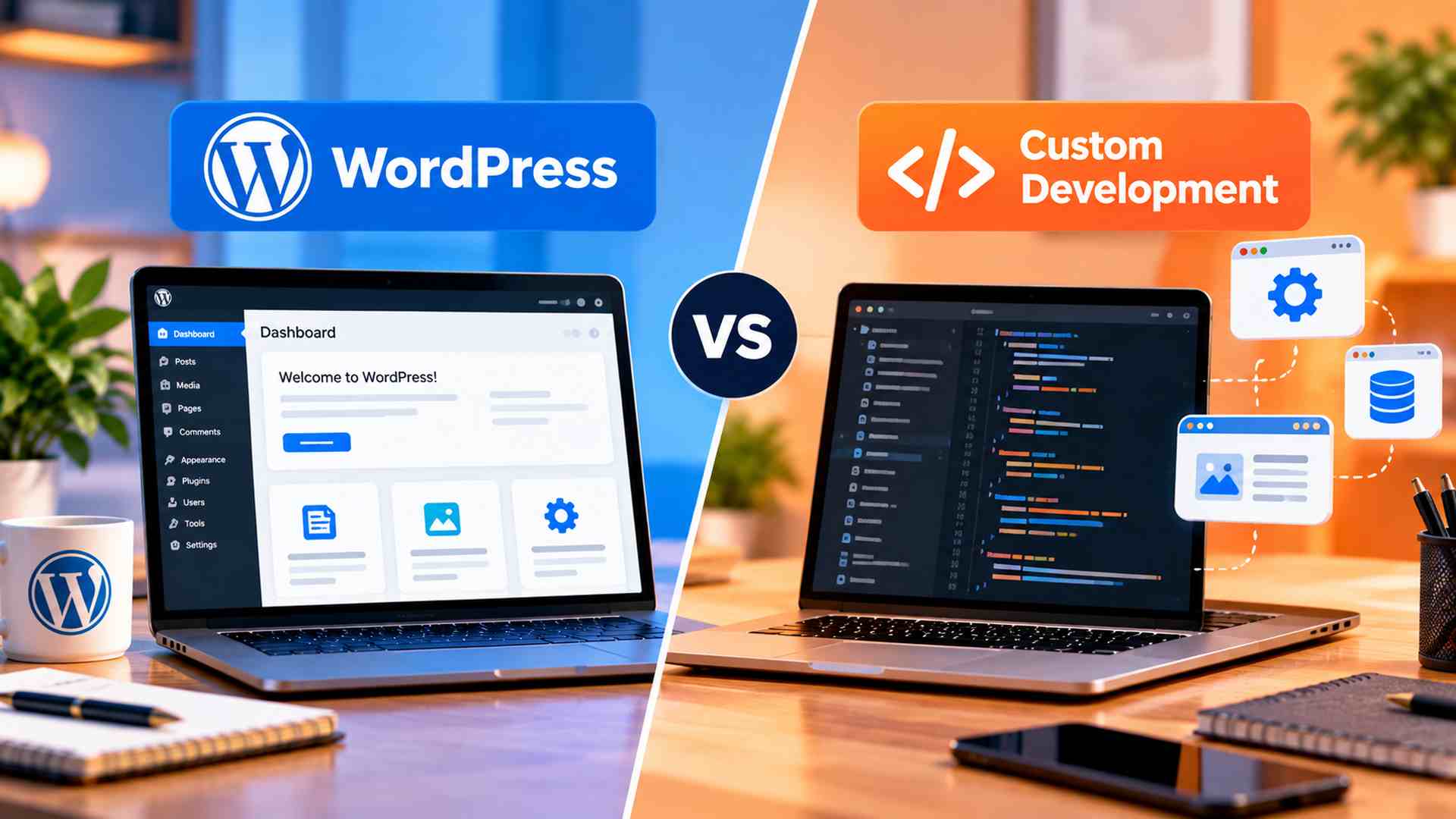
Before thinking about colors, layouts, or animations, there is a more important decision to make: how should the website be built? For many companies, that decision comes down to WordPress vs Custom Development.
WordPress can help businesses launch faster and manage content easily, while a custom-built website gives developers more freedom to create unique functionality, integrations, and user experiences. Neither option is automatically better. The right choice depends on your goals, budget, timeline, internal resources, and future growth plans.
What Is WordPress Development?
WordPress is a content management system that allows businesses to create and manage websites through an administrative dashboard. Professional CMS development services can help businesses configure WordPress or other CMS platforms with the right themes, custom features, integrations, security, and scalable architecture.
This makes WordPress a practical option for company websites, service-based businesses, blogs, portfolios, landing pages, news websites, and many small to medium-sized online stores.
Where WordPress Works Well
- Faster launch: Many standard website features already exist and can be configured quickly.
- Easy content management: Teams can update pages, publish blogs, upload images, and make routine content changes without editing code.
- Lower starting cost: Businesses can often launch with a smaller initial investment than a fully custom platform.
- Large ecosystem: WordPress supports tools for SEO, forms, analytics, eCommerce, security, performance, booking, and many other common needs.
- Flexible design: Developers can create custom themes and layouts instead of relying only on ready-made templates.
Where WordPress Can Become Challenging
WordPress becomes harder to manage when a website depends on too many plugins or when the business needs highly specialized workflows. Poorly selected plugins can create compatibility issues, unnecessary scripts, security risks, or performance problems.
That does not mean WordPress is inherently slow or insecure. A well-built WordPress website can be fast, secure, and scalable. The real difference is how carefully the site is developed, hosted, optimized, and maintained.
What Is Custom Website Development?
Custom website development means creating a website or web application around the specific requirements of a business. An experienced web development company can design the architecture, database, user interface, APIs, integrations, and functionality specifically for the project.
This approach is commonly used when a company needs more than a traditional marketing website. Examples include customer portals, SaaS platforms, advanced dashboards, marketplaces, real-time systems, custom booking engines, complex eCommerce workflows, or applications that connect deeply with internal business software.
Where Custom Development Works Well
- Unique functionality: Features can be built around the exact business process.
- Greater technical control: Developers control the codebase, architecture, database, integrations, and deployment process.
- Scalable systems: The architecture can be planned for higher traffic, larger databases, or complex user activity.
- Custom integrations: CRM, ERP, payment, inventory, logistics, analytics, or proprietary systems can be connected directly.
- Distinct user experience: The interface does not have to follow the structure of a theme or standard plugin.
Challenges of Custom Development
Custom development usually requires more planning, a larger initial budget, and a longer development cycle. It also needs skilled developers for future maintenance and upgrades. For a simple five-page business website, that extra investment may not provide enough value.
However, when the website itself is a core part of business operations, the additional control can justify the cost.
WordPress vs Custom Development: Key Differences
The easiest way to understand WordPress vs Custom Development is to compare the two approaches across the factors that matter most to a business.
| Comparison Area | WordPress Development | Custom Development |
|---|---|---|
| Initial Cost | Usually lower for standard business websites. | Usually higher because more features are designed and coded specifically for the project. |
| Development Time | Often faster because the CMS and many common features already exist. | Usually longer because requirements, architecture, development, and testing are more extensive. |
| Content Management | Easy for non-technical teams through the WordPress dashboard. | Depends on whether a custom CMS or content-management interface is included. |
| Design Freedom | High with custom themes, although the CMS structure still influences development. | Very high because the interface can be designed around the exact product or business requirements. |
| Custom Features | Often handled through plugins, extensions, APIs, and custom WordPress development. | Features can be created specifically for the business without depending on plugin limitations. |
| Maintenance | Requires regular updates for WordPress core, themes, plugins, security, and backups. | Requires developer support, software updates, testing, monitoring, and infrastructure maintenance. |
| Scalability | Can scale well when properly engineered, but highly specialized requirements may become difficult. | Architecture can be planned specifically for expected users, traffic, data, and workflows. |
|
Best Fit |
Corporate websites, blogs, portfolios, landing pages, service websites, and standard eCommerce. |
SaaS products, portals, marketplaces, complex eCommerce, dashboards, and specialized business platforms. |
Cost: Which Option Requires More Investment?
Cost is one of the biggest factors in the WordPress vs Custom Development decision. WordPress usually has a lower entry cost because the content-management system and many standard capabilities are already available.
However, businesses should not compare only the initial development quotation. A WordPress website may also involve premium plugins, theme licenses, managed hosting, security services, maintenance, performance optimization, and future customization.
Custom development normally requires a larger investment at the beginning because more of the system is created specifically for the project. Long-term costs can include hosting, monitoring, feature development, security work, and developer support.
The better question is not simply, “Which one is cheaper?” It is, “Which approach gives the business the functionality it needs without creating unnecessary technical complexity?”
Which Option Is Faster to Launch?
For a standard business website, WordPress is usually faster to launch. The CMS already provides a foundation for pages, media, users, navigation, blogging, and other common features.
Custom development often requires a longer process, including requirement analysis, system planning, UX design, UI design, frontend development, backend development, database work, integrations, testing, and deployment.
If speed to market is critical and your requirements are conventional, WordPress may be the more practical route. If the project includes unique software functionality, additional development time may be necessary to build the right foundation.
Flexibility and Custom Features
WordPress is more flexible than many businesses assume. Developers can build custom themes, plugins, APIs, WooCommerce extensions, post types, membership systems, and integrations.
The challenge appears when a business starts combining many unrelated plugins to reproduce a workflow that is unique to the company. At that point, the system can become difficult to maintain.
For example, a logistics company might need customers to log in, track shipments, download invoices, receive live status updates, and connect data with an internal management system. A custom application can be designed around that workflow directly instead of trying to connect several independent plugins.
Website Performance and Core Web Vitals
Performance depends heavily on development quality rather than the platform name alone.
A WordPress site can become slow if it uses an oversized theme, too many plugins, unoptimized images, heavy page builders, unnecessary tracking scripts, or low-quality hosting. On the other hand, a carefully built WordPress site can load quickly when caching, image optimization, database management, hosting, and frontend assets are handled properly.
Custom development gives developers more control over what code is loaded, how data is requested, and how the application behaves. That can be valuable for projects with complex functionality or strict performance requirements.
WordPress vs Custom Development for SEO
WordPress vs Custom Development for SEO: What Really Matters?
SEO should be considered during development, regardless of the platform. In a WordPress vs Custom Development comparison, both approaches can support strong organic search performance when technical SEO is implemented correctly.
WordPress makes many SEO tasks convenient through tools that help manage titles, meta descriptions, XML sitemaps, canonical URLs, redirects, schema markup, and indexing settings.
A custom website can also include all of these capabilities, but they must be planned and developed as part of the system.
Important SEO requirements include:
- Clean and crawlable site architecture
- SEO-friendly URL structures
- Correct heading hierarchy
- Unique title tags and meta descriptions
- Canonical URLs
- XML sitemaps
- Robots and indexing controls
- Structured data
- Internal linking
- Mobile usability
- Fast page performance
- Optimized images
Choosing WordPress does not guarantee good SEO, and choosing a custom solution does not guarantee better rankings. Development quality, content quality, site structure, performance, and ongoing SEO work matter far more.
Security and Maintenance
Security is another area where businesses often oversimplify the WordPress vs Custom Development comparison.
WordPress needs regular updates because the core software, themes, and plugins evolve over time. Security risks often increase when plugins are outdated, poorly maintained, or installed unnecessarily.
Custom applications avoid many public plugin dependencies, but they still require secure coding, access control, software updates, infrastructure protection, backups, testing, and monitoring.
Neither approach is automatically secure. A secure website is the result of good development practices and consistent maintenance.
Scalability and Future Business Growth
Your website requirements may change significantly as your business grows. A simple company website can eventually need customer accounts, advanced forms, automation, integrations, larger product catalogs, new payment methods, multilingual content, or personalized experiences.
This is why the WordPress vs Custom Development decision should consider where your business is heading, not only what it needs today.
WordPress can scale for many content-focused and eCommerce projects when the architecture is planned carefully. Businesses with more advanced store requirements may also need professional eCommerce development for custom checkout flows, integrations, inventory systems, or scalable shopping functionality. However, if future growth depends on complex proprietary functionality, custom development may offer a cleaner path.
When Should You Choose WordPress?
WordPress is usually a strong choice when your primary goal is publishing, marketing, lead generation, or standard eCommerce.
It is particularly suitable for:
- Small and medium-sized businesses
- Professional service companies
- Digital agencies
- Consultants and personal brands
- Corporate websites
- Blogs and publications
- Portfolio websites
- Landing-page websites
- Small and medium-sized WooCommerce stores
For example, a consulting business that needs service pages, case studies, blog content, contact forms, and appointment booking may have no practical reason to build a content-management system from scratch.
When Should You Choose Custom Development?
Custom development becomes more appropriate when the website acts like a software product or plays a central role in business operations.
It may be the better approach if you require:
- Custom customer portals
- Complex account permissions
- Advanced dashboards
- Marketplace functionality
- Real-time systems
- Specialized payment logic
- Large-scale data processing
- Deep CRM or ERP integrations
- Custom inventory workflows
- Unique subscription or membership systems
In these cases, building the system around the business requirement can be more efficient than continuously adapting pre-built plugins.
Can You Use WordPress and Custom Development Together?
Yes. Businesses do not always need to choose only one approach.
A company can use WordPress for its marketing website and build a separate custom application for customers or internal operations.
app.example.com → Custom customer platform
This hybrid approach gives the marketing team an easy way to manage public content while developers maintain full control over complex application functionality.
How to Choose the Right Option for Your Business
Before making a final WordPress vs Custom Development decision, answer a few practical questions.
1. What Does the Website Need to Do?
List the actual functions your customers and employees need. Separate essential requirements from features that would simply be nice to have.
2. What Is Your Budget?
If your requirements are standard and your budget is limited, WordPress may provide more value at the beginning. If the website will be a core business system, a larger custom investment may be justified.
3. How Quickly Do You Need to Launch?
WordPress can shorten the timeline for conventional websites. Custom development requires more time when the project includes specialized architecture and features.
4. Who Will Manage Content?
If marketing staff regularly publish pages, blogs, case studies, or landing pages, an easy content-management interface should be part of the decision.
5. What Will You Need in the Future?
Think beyond the current project. Consider user growth, integrations, automation, multilingual requirements, eCommerce expansion, and any digital services you may introduce later.
Common Mistakes Businesses Should Avoid
One mistake is choosing WordPress only because it appears cheaper. Another is choosing custom development simply because it sounds more advanced.
A straightforward company website does not always need a custom application. At the same time, a complex digital platform should not be forced into a collection of plugins just to reduce initial costs.
The technology should support the business strategy, not make the business change its processes to fit unnecessary technical limitations.
Frequently Asked Questions
Is WordPress good for a business website?
Yes. WordPress can work very well for business websites, especially when the main requirements are service pages, blogs, portfolios, lead generation, or standard eCommerce functionality.
Is custom development always better than WordPress?
No. Custom development provides more control, but that does not mean every project needs it. A standard company website may be faster and more cost-effective to build with WordPress.
Which option is better for SEO?
Both can perform well in search engines. SEO results depend on technical implementation, website structure, content, performance, internal linking, and ongoing optimization rather than the platform alone.
Can WordPress handle a large website?
Yes. WordPress can support large websites when hosting, caching, database architecture, code quality, and content management are planned properly. Highly specialized application requirements may still be better suited to a custom system.
Is custom development more secure?
Custom development gives developers greater control over the codebase, but security still depends on secure coding, testing, infrastructure, updates, monitoring, and maintenance.
Can I move from WordPress to a custom website later?
Yes. Businesses often start with WordPress and move to a custom platform when their operational or technical requirements become more complex. Planning data structures and URLs carefully can make future migration easier.
Final Thoughts
There is no universal winner in the WordPress vs Custom Development debate. WordPress is a practical option for businesses that want a professional, content-friendly website with a faster launch and lower initial complexity.
Custom development is more suitable when a business needs specialized functionality, advanced integrations, proprietary workflows, or a digital platform built around unique operational requirements.
The best decision comes from understanding what your website needs to accomplish today, how your business may change tomorrow, and which technical approach can support that growth without unnecessary cost or complexity.