

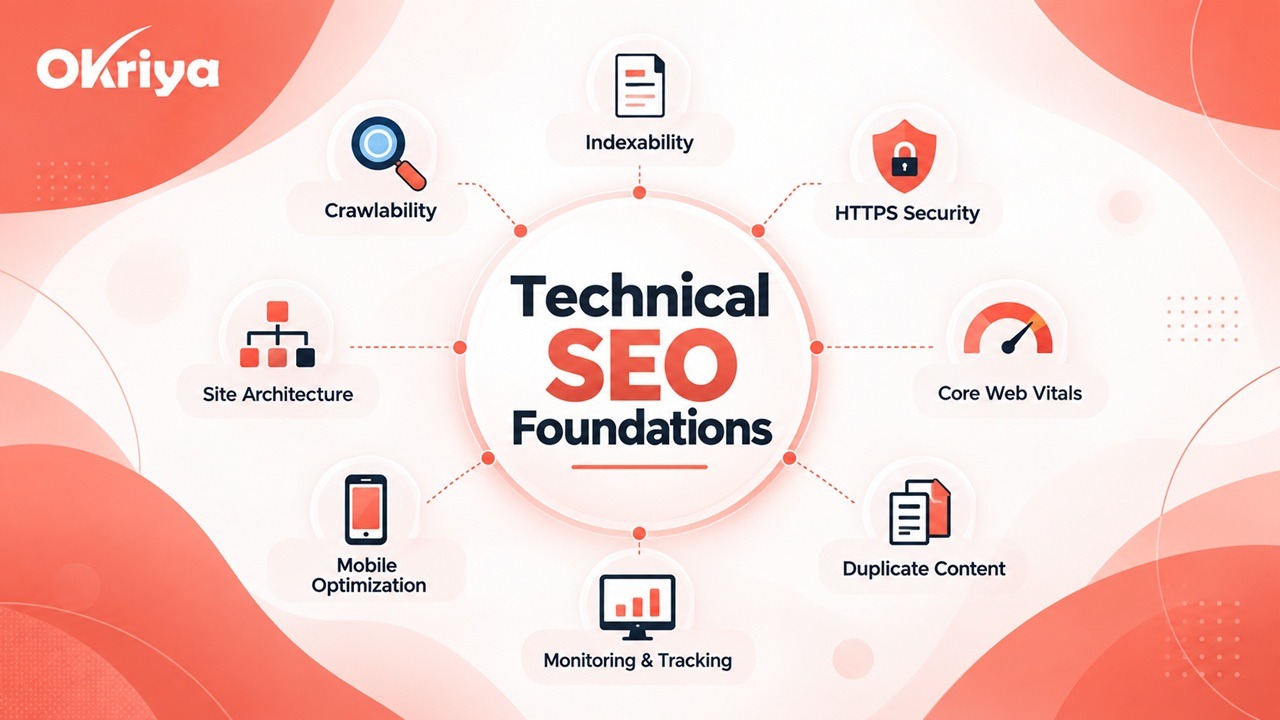
A website can have excellent design and useful content, but it may still struggle in search if search engines cannot crawl, understand, and index it properly. That is why Technical SEO Foundations should be established before relying heavily on content creation or link building.
Technical SEO focuses on the systems behind a website, including crawlability, indexing, HTTPS, site architecture, performance, mobile usability, structured data, and duplicate-content management. A professional SEO service should address these technical elements alongside content and search visibility. These elements create the technical framework that supports both users and search engines.
Strong Technical SEO Foundations can reduce crawl problems, improve index coverage, create a better browsing experience, and make future SEO work easier to manage. Instead of fixing technical problems after a website grows, it is usually better to build the right structure from the beginning.
Technical Foundations of SEO: Crawlability and Indexability
The Technical Foundations of SEO begin with a simple requirement: search engines must be able to discover and access your important pages.
Crawlability refers to whether search engine bots can reach and navigate a page. Indexability determines whether that page is eligible to appear in search results. Both need to work together.
Several technical elements influence this process:
- robots.txt: Controls which areas crawlers can access.
- XML sitemap: Provides search engines with a list of important URLs.
- Canonical tags: Indicate the preferred version of similar or duplicate pages.
- Internal links: Help crawlers discover pages naturally.
- Redirects: Guide users and search engines from old URLs to relevant new ones.
Broken links, redirect loops, accidental crawler blocks, or isolated pages can make discovery more difficult.
A clean crawl and indexing setup is therefore one of the most important Technical SEO Foundations for any website.
Technical SEO Fundamentals: Use a Secure HTTPS Setup
The Technical SEO Fundamentals also include website security.
HTTPS encrypts communication between a visitor’s browser and the server. This is especially important for websites that collect information through contact forms, account registrations, checkout pages, or online payments.
Your HTTPS setup should include three basic steps.
Technical SEO Foundations for HTTPS Configuration
First, install a valid SSL certificate and make sure it covers every important version of the website.
Next, redirect HTTP pages to their HTTPS equivalents using permanent redirects. This helps prevent users and search engines from accessing duplicate secure and non-secure versions.
Finally, check for mixed content. Images, scripts, fonts, and stylesheets should also load through HTTPS rather than insecure HTTP connections.
A consistent HTTPS setup improves security and gives your website a cleaner technical structure.
Build a Clear and Logical Website Architecture
Site architecture determines how pages are organized and connected.
A well-structured website helps users find information easily while also giving search engines a clearer understanding of page hierarchy and relationships.
Important pages should not be buried unnecessarily deep inside the website. Whenever possible, key service, product, category, and informational pages should be reachable through a clear navigation structure.
Good architecture normally includes:
- Logical categories
- Simple navigation
- Descriptive URLs
- Contextual internal links
- Clear page hierarchy
- No important orphan pages
URLs should also remain simple and understandable. Short, descriptive URLs are generally easier for users to recognize and easier to manage over time.
Good internal linking is another essential part of Technical SEO Foundations. Links should connect relevant pages and use anchor text that clearly describes the destination.
Optimize Speed and Core Web Vitals
Website performance affects how visitors experience a page. Slow-loading or unstable pages can frustrate users and make a website feel difficult to use.
Core Web Vitals provide useful performance measurements. The reference article focuses on three major metrics: Largest Contentful Paint, Interaction to Next Paint, and Cumulative Layout Shift.
Technical SEO Fundamentals for Better Performance
The Technical SEO Fundamentals of page performance include reducing unnecessary page weight and improving how website resources are delivered.
Start with practical improvements such as:
- Compressing large images
- Using appropriately sized images
- Removing unnecessary plugins
- Reducing unused scripts
- Minifying CSS and JavaScript where appropriate
- Using browser caching
- Improving server response time
- Using a CDN when it benefits the website
Performance optimization should not focus only on achieving a score. The real objective is to create pages that load quickly, remain stable, and respond smoothly when users interact with them.
Strong performance is an important part of maintaining reliable Technical SEO Foundations.
Technical Foundations of SEO for Mobile Usability
The Technical Foundations of SEO should also support visitors using smartphones and tablets.
A responsive website should adapt its layout to different screen sizes without requiring users to zoom, scroll horizontally, or struggle with navigation.
Pay attention to:
- Readable text sizes
- Proper spacing between buttons
- Flexible layouts
- Responsive images
- Simple navigation
- Mobile-friendly forms
- Fast mobile loading
Do not test only the homepage. Service pages, blog posts, product pages, contact forms, category pages, and checkout flows should also work correctly on smaller screens.
Consistent mobile usability strengthens both the technical quality and overall user experience of a website.
Add Relevant Structured Data
Structured data helps search engines interpret specific information on a page more clearly.
Schema markup can describe entities and relationships such as the business behind a website, page hierarchy, products, services, articles, or other supported content types.
The reference article specifically recommends Organization, Breadcrumb, Service, and Review-related structured data for relevant business websites.
Technical SEO Foundations for Schema Markup
When structured data is relevant, implement it accurately rather than adding every schema type available in an SEO plugin.
For example:
- Organization schema can describe your business.
- Breadcrumb schema can represent website hierarchy.
- Service-related markup can provide structured information about offerings where appropriate.
- Article markup can support blog and editorial content.
Structured data should accurately reflect information visible on the page.
Correct implementation strengthens Technical SEO Foundations by making important page information more structured and understandable.
Eliminate Duplicate and Thin Pages
Duplicate and low-value pages can make a website unnecessarily complicated.
Common causes include URL parameters, filters, old test pages, empty archives, duplicate categories, similar service pages, and automatically generated URLs.
Start by identifying URLs that serve little unique purpose.
Depending on the situation, you may need to:
- Consolidate overlapping content
- Redirect outdated pages
- Apply appropriate canonical tags
- Remove unnecessary pages
- Prevent low-value pages from being indexed
- Improve thin pages with useful original information
The goal is not simply to reduce the number of URLs. Each important indexed page should have a clear purpose and provide distinct value.
Managing duplicate content is therefore another important component of Technical SEO Foundations.
Technical SEO Fundamentals: Set Up Monitoring
The Technical SEO Fundamentals do not end once the website is launched.
Technical issues can appear after plugin updates, redesigns, migrations, new content publication, development changes, or changes to site architecture.
Monitoring tools can help identify problems before they affect large sections of the website.
Important tools can include:
- Google Search Console
- Google Analytics 4
- PageSpeed Insights or Lighthouse
- Screaming Frog
- Semrush or similar auditing platforms
Google Search Console can help monitor indexing, search visibility, and technical issues, while analytics tools help measure user behavior and conversions.
Technical crawling tools can also identify broken links, redirects, duplicate URLs, and other structural problems.
The original article likewise recommends regular technical audits and ongoing monitoring rather than treating technical SEO as a one-time setup.
Maintain Technical SEO Foundations Over Time
A website continuously changes. New pages are published, services are updated, plugins change, redirects are added, and content is removed.
Because of this, Technical SEO Foundations need regular maintenance.
Review your website periodically for:
- Crawl errors
- Broken links
- Redirect problems
- Duplicate content
- Indexing changes
- Performance regressions
- Mobile usability issues
- Structured data errors
- Outdated XML sitemap URLs
Major website changes should receive additional attention.
After a redesign or migration, confirm that important URLs remain accessible, redirects work correctly, canonical tags point to the intended pages, and search engines can still discover important content.
Regular monitoring prevents small technical problems from becoming larger SEO issues.
Technical SEO Foundations: Website Launch Checklist
Before launching a new website or completing a major redesign, review the most important technical elements. Our guide on how to launch a website also covers the broader planning, design, testing, SEO, security, and deployment steps involved in a successful website launch.
Use this checklist:
- HTTPS is active across the entire website
- HTTP URLs redirect correctly to HTTPS
- robots.txt does not block important pages
- XML sitemap contains important indexable URLs
- Canonical tags point to the correct pages
- Important pages have internal links
- Broken links and redirect loops are fixed
- Mobile layouts work correctly
- Core Web Vitals and page performance are reviewed
- Relevant structured data is implemented
- Google Search Console is configured
- Analytics tracking works correctly
The reference article similarly identifies HTTPS, robots.txt, XML sitemaps, canonicals, performance, mobile responsiveness, structured data, analytics, and internal links as essential pre-launch checks.
Completing these checks gives the website a stronger technical starting point before content marketing and other SEO efforts expand.
Final Thoughts
Strong search visibility starts with a website that search engines can access, understand, and process efficiently.
The Technical Foundations of SEO cover the systems that support that process, from crawling and indexing to HTTPS, site architecture, mobile usability, performance, structured data, and ongoing monitoring.
Understanding the Technical SEO Fundamentals also helps businesses prevent avoidable problems before they affect larger parts of the website.
Most importantly, Technical SEO Foundations should not be treated as a one-time project. Websites continue to evolve, which means their technical health needs to be monitored and maintained as they grow.
Build the foundation correctly, review it regularly, and your content and broader SEO strategy will have a much stronger platform to work from. Small businesses can also follow practical SEO advice to strengthen content, local visibility, on-page optimization, and long-term organic growth.