

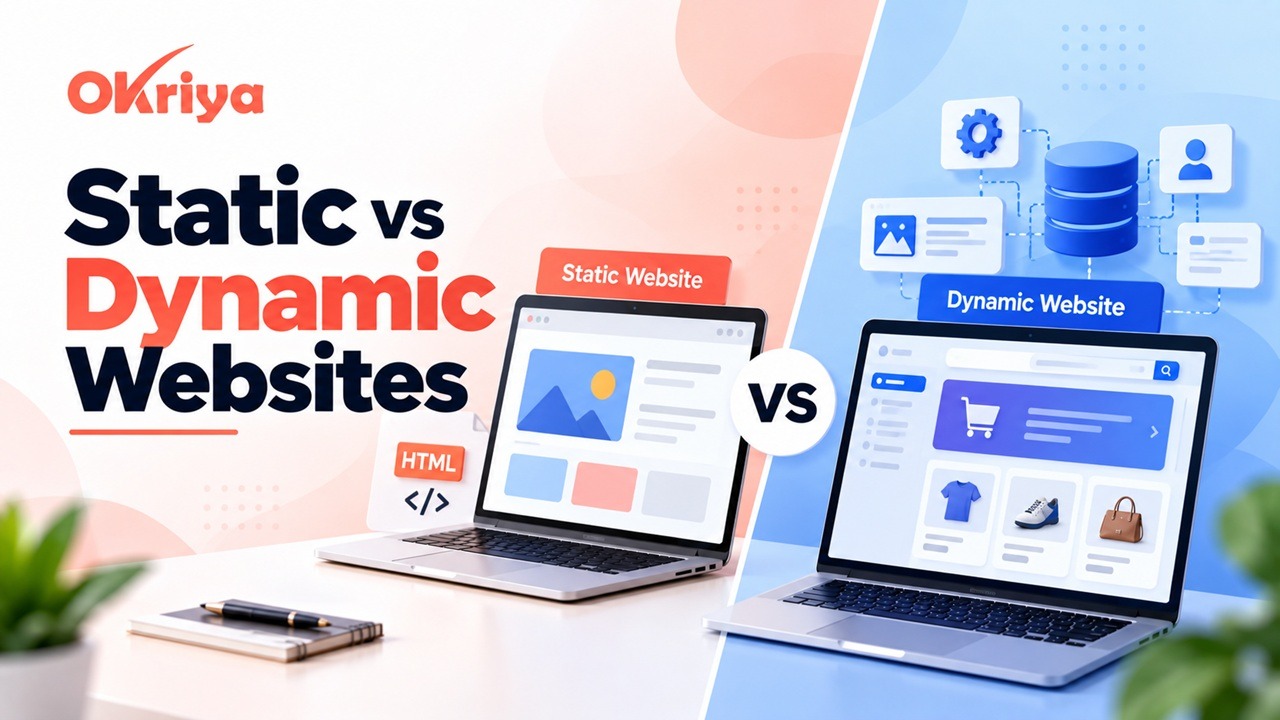
Websites may look similar from the outside, but the technology behind them can be very different. Some websites display almost the same content to every visitor, while others change their content depending on user activity, stored information, location, account details, or other factors.
Understanding Static vs Dynamic Websites is important when planning a new website because the structure you choose can affect development time, website speed, maintenance, scalability, security, and overall functionality.
A simple business website may work perfectly with static pages, while an ecommerce store, customer portal, booking platform, or membership website will usually require dynamic functionality.
In this guide, we will explain the differences between static and dynamic websites, their advantages and disadvantages, common use cases, and how to decide which approach is suitable for your project.
What Are Static vs Dynamic Websites?
The main difference between Static vs Dynamic Websites is how website content is created and delivered to visitors.
A static website generally contains pre-built HTML pages stored on a web server. When someone visits a page, the server sends the existing file directly to the browser.
A dynamic website can generate or modify content when a visitor requests a page. It may communicate with a database, application server, CMS, API, or other systems before showing the final content.
For example, a simple company profile containing services, contact information, and an About page could be static. An ecommerce website showing customer accounts, product availability, shopping carts, and personalized recommendations is usually dynamic.
Static vs Dynamic Website: What Is a Static Website?
A static website consists of web pages whose core content is usually prepared in advance. The pages are commonly created using technologies such as HTML, CSS, and JavaScript.
When visitors request a static page, the server can deliver that page without generating its content from a database every time.
Static websites are often suitable for websites where information does not need frequent changes.
Common Features of a Static Website
Typical characteristics include:
- Pre-built HTML pages
- Fast page delivery
- Simple hosting requirements
- Limited database dependency
- Fewer server-side processes
- Content that changes relatively infrequently
- Straightforward deployment
For example, a small portfolio website containing Home, About, Services, Portfolio, and Contact pages could be created using a static structure.
Advantages of Static Websites
One important advantage of static websites is performance. Since much of the page is already prepared, the server can deliver files quickly.
Static websites may also have a smaller technical footprint because fewer server-side components are required.
Other advantages can include:
- Faster loading: Pre-generated pages can be delivered quickly.
- Simple hosting: Static files can be hosted on many lightweight hosting platforms or CDNs.
- Lower maintenance: Fewer backend components may reduce ongoing technical maintenance.
- Strong security potential: A smaller server-side attack surface can reduce certain security risks.
- Easy deployment: Developers can often publish updated files without managing a complex backend.
However, static does not mean completely non-interactive. JavaScript and third-party services can still support contact forms, animations, search features, analytics, and other interactive elements.
Disadvantages of Static Websites
Static websites also have limitations.
Updating hundreds of individually managed pages can become inefficient if the website does not use a static site generator or another organized content workflow.
Other possible disadvantages include:
- More manual work for frequent content updates
- Limited built-in user personalization
- Less suitable for complex user accounts
- Database-driven features require additional technology
- Large content-heavy websites may require more structured publishing tools
This is why the decision between Static vs Dynamic Websites depends heavily on the purpose and future requirements of the project.
Dynamic vs Static: What Is a Dynamic Website?
A dynamic website creates or changes content using server-side processing, client-side logic, databases, APIs, or a combination of these technologies.
Instead of serving only a fixed page, the system can retrieve information and build content based on the visitor’s request.
For example, when someone logs into an online store, the website may display their account information, previous orders, saved products, and personalized recommendations. Different users can therefore see different content on the same URL.
Common Features of Dynamic Websites
Dynamic websites commonly support:
- Databases
- User registration and login
- Content management systems
- Ecommerce functionality
- Product inventories
- Search and filtering
- User dashboards
- Personalized content
- Booking systems
- Comments or community features
- Real-time or frequently updated information
Popular platforms such as WordPress can generate dynamic pages from information stored in a database, although modern websites often combine dynamic and static techniques. Businesses that need easier content management may benefit from professional CMS development services.
Advantages of Dynamic Websites
Dynamic websites are useful when a business needs advanced functionality or regularly updated content.
Major advantages include:
- Easy content management: Administrators can update content through a CMS.
- Better scalability for structured content: Large numbers of pages can be generated from templates and databases.
- Advanced functionality: User accounts, dashboards, ecommerce, bookings, and other complex features can be supported.
- Personalization: Content can change according to the visitor or application state.
- Automation: Product pages, category pages, search results, and similar content can be generated automatically.
For businesses planning to continuously expand their website, dynamic architecture can provide greater flexibility.
Disadvantages of Dynamic Websites
Dynamic websites can require more development and maintenance because they often depend on databases, backend applications, plugins, integrations, and other systems.
Possible disadvantages include:
- More complex development
- Higher hosting requirements in some cases
- Additional database and server maintenance
- More areas that need security management
- Performance issues if the website is poorly optimized
Good development practices, caching, CDNs, database optimization, and modern hosting infrastructure can reduce many of these challenges.
Static vs Dynamic Websites: Main Differences
When comparing Static vs Dynamic Websites, it is useful to look beyond appearance. Visitors may not even realize whether a website is static or dynamic because both can have modern designs and interactive interfaces.
The real differences exist in how the website stores, generates, manages, and updates information..
| Factor | Static Website | Dynamic Website |
|---|---|---|
| Content Delivery | Usually pre-built | Can be generated when requested |
| Database | Often not required | Commonly used |
| Website Speed | Often very fast | Depends on application and optimization |
| Development | Usually simpler for small websites | Usually more complex |
| Content Updates | May require editing/building files | Often managed through a CMS or admin panel |
| Personalization | Limited by default | Highly flexible |
| User Accounts | Less common | Commonly supported |
| Scalability | Good for suitable content structures | Strong for large database-driven platforms |
| Maintenance | Often lower | Usually requires more ongoing maintenance |
| Best Use | Simple or content-focused websites | Interactive or feature-rich websites |
This comparison shows that Static vs Dynamic Websites is not simply a question of which technology is better. Each approach solves different types of problems
Static vs Dynamic Website: Performance and Speed
Performance is one of the most discussed differences in a Static vs Dynamic Website comparison.
Static pages can often load quickly because the server has fewer operations to complete before sending the page. Static websites can also work effectively with content delivery networks, allowing files to be served from locations close to visitors.
Dynamic websites may perform additional tasks, such as database queries, authentication checks, API requests, or server-side rendering.
However, a dynamic website does not automatically mean a slow website.
Modern performance techniques can include:
- Server-side caching
- Page caching
- Object caching
- Database optimization
- CDN integration
- Image optimization
- Code splitting
- Lazy loading
- Browser caching
A well-developed dynamic website can deliver excellent performance, while a poorly optimized static website can still provide a bad user experience because of oversized images, unnecessary scripts, or inefficient design.
Static vs Dynamic Websites for SEO
Search engines can rank both Static vs Dynamic Websites when they are properly developed and optimized.
SEO success depends more on content quality, crawlability, website structure, user experience, technical implementation, internal linking, page speed, and relevance than on whether the website is classified as static or dynamic.
Static websites may provide performance benefits and simple HTML structures, which can make technical optimization straightforward.
Dynamic websites can also perform extremely well in search results, especially when they allow businesses to manage large amounts of content efficiently.
Important SEO considerations include:
- Unique page titles
- Meta descriptions
- Proper heading hierarchy
- Clean URLs
- Internal linking
- Mobile responsiveness
- Fast page loading
- XML sitemaps
- Canonical tags
- Structured data
- Indexable HTML content
Developers should also make sure that important dynamic content can be accessed and understood by search engines.
Dynamic vs Static: Which Is Better for Business Websites?
There is no universal winner in the Dynamic vs Static debate.
A business should choose its website architecture based on what the website actually needs to accomplish.
A static website may be appropriate when:
- The website has relatively few pages.
- Content does not change frequently.
- There are no customer accounts.
- Advanced database functionality is unnecessary.
- Speed and simple deployment are priorities.
- The business mainly needs an informational online presence.
A dynamic website may be better when:
- Content changes frequently.
- Multiple team members need to update pages.
- Users need accounts or dashboards.
- The business sells products online.
- The website needs booking functionality.
- Information comes from a database.
- The site contains hundreds or thousands of structured pages.
- Personalized experiences are required.
The right choice between Static vs Dynamic Websites should therefore start with business requirements instead of technology preferences. An experienced web development company can help evaluate your functionality, content, scalability, and future requirements before recommending the right architecture.
Static vs Dynamic Websites for Ecommerce
Most modern ecommerce websites use dynamic functionality because online stores need to manage constantly changing information. A professional eCommerce development solution can combine product management, customer accounts, payments, inventory, and scalable dynamic functionality.
An ecommerce platform may need to process:
- Product information
- Prices
- Inventory
- Shopping carts
- Customer accounts
- Orders
- Payment information
- Product filters
- Search results
- Shipping options
Managing these features with completely static pages would be impractical for most businesses.
However, ecommerce websites can still use static technologies for certain sections. For example, landing pages, documentation, campaign pages, or informational content may be pre-generated while product and checkout features remain dynamic.
This hybrid approach has become increasingly common in modern web development.
When Should You Choose a Static Website?
Consider a static website when your project is simple, content changes are limited, and advanced server-side functionality is unnecessary.
Static architecture can work particularly well for:
- Personal portfolios
- Event landing pages
- Small company websites
- Product launch pages
- Documentation sites
- Campaign microsites
- Simple informational websites
For these projects, choosing a complicated dynamic system may introduce unnecessary maintenance.
When Should You Choose a Dynamic Website?
A dynamic website becomes more practical when a website needs to continuously receive, store, process, or display changing information.
Common examples include:
- Ecommerce stores
- News websites
- Membership websites
- Learning management systems
- Real estate portals
- Job portals
- Social platforms
- Online marketplaces
- Booking websites
- Customer dashboards
If your business expects the platform to expand significantly, consider future functionality while evaluating Static vs Dynamic Websites rather than focusing only on current requirements.
Static vs Dynamic Websites: Can You Use Both?
Yes. A website does not always need to be completely static or completely dynamic. Modern development architectures frequently combine both approaches.
For example, a business may pre-generate its marketing pages for fast delivery while using dynamic functionality for customer accounts, search, payments, dashboards, or personalized information.
Frameworks and modern web development platforms can also generate static pages during deployment while dynamically rendering other pages when required.
This means the Static vs Dynamic Websites decision does not always have to be an either-or choice. A hybrid architecture may provide the right balance of performance, flexibility, and functionality.
How to Choose Between Static vs Dynamic Websites
Before choosing a website architecture, consider both current requirements and future plans.
Ask the following questions:
- How frequently will the content change?
Frequent publishing may benefit from a CMS or dynamic content system. - Will users need accounts?
Login systems and personalized dashboards usually require dynamic functionality. - Will the website use a database?
Product catalogs, bookings, user profiles, and other structured information often depend on databases. - How large will the website become?
Consider how content will be created and managed when the site grows. - Who will maintain the website?
Non-technical teams may prefer a CMS that allows content editing without changing code. - What functionality will be added later?
Planning for future features can prevent expensive architecture changes. - What level of performance is required?
Both approaches can perform well, but the optimization strategy may be different.
Understanding these requirements makes the Static vs Dynamic Websites decision much easier.
Final Thoughts
Choosing the right website architecture requires more than comparing technical terminology. Your decision should reflect the purpose of the website, expected traffic, content workflow, required functionality, maintenance resources, and long-term business plans.
Static websites can provide simplicity, speed, and lower technical complexity for projects with relatively stable content. Dynamic websites provide the flexibility needed for databases, ecommerce, user accounts, content management, personalization, and advanced applications.
When evaluating Static vs Dynamic Websites, focus on what your users need today and what your business may require in the future. In many modern projects, combining static and dynamic technologies can also provide an effective balance between performance and functionality.