

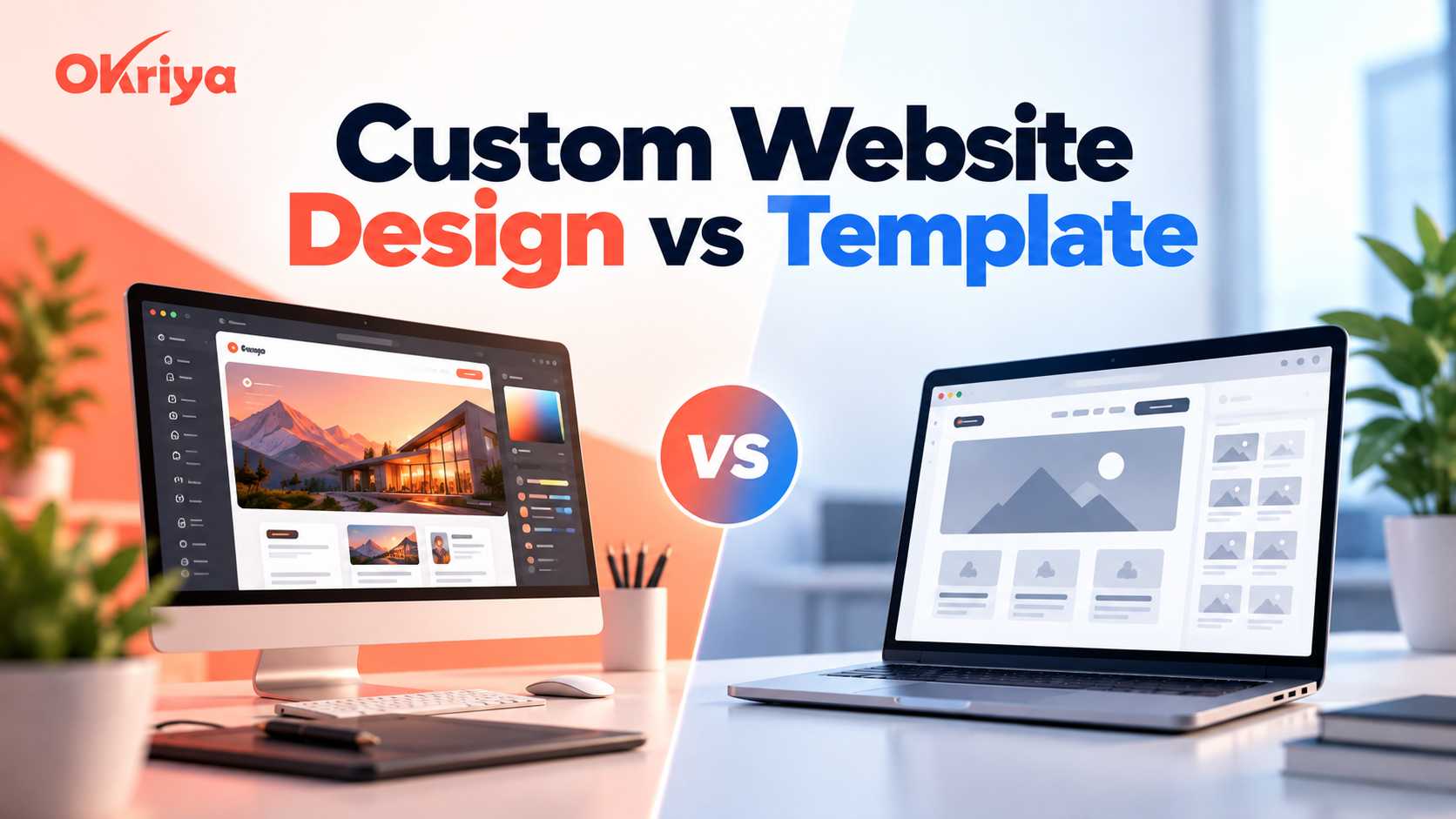
Your website is often the first place potential customers learn about your business. It introduces your brand, explains your services, builds trust, and gives visitors a way to take action. Before development begins, however, there is an important decision to make: should you use a ready-made template or invest in a website built specifically for your business?
Custom Website Design vs Template is a practical comparison every business should understand before choosing a development approach. Templates are usually faster and more affordable to launch, while custom websites offer greater flexibility, stronger brand control, and more room for future expansion.
There is no single solution that fits every company. The right choice depends on your budget, timeline, business model, required features, marketing strategy, and long-term plans. This guide explains the difference between a custom website vs template website so you can make a more informed decision.
What Is a Template Website?
A template website is created using a pre-designed layout or theme. Instead of designing every page and interface element from the beginning, you choose an existing template and customize elements such as text, images, colors, fonts, menus, and page sections.
Popular website platforms such as WordPress, Shopify, Wix, Squarespace, and Webflow offer large collections of free and premium templates. Many include common features such as contact forms, galleries, blogs, product pages, and responsive layouts.
Templates can be a sensible choice for freelancers, small businesses, personal portfolios, temporary campaign websites, and companies that need a basic online presence quickly. They reduce the amount of design and development work required before launch.
Advantages of a Template Website
Faster development: Much of the design structure already exists, so the website can usually be prepared more quickly than a fully custom build.
Lower initial cost: Businesses can avoid much of the planning, UI design, and front-end development required for a website built from scratch.
Easy content management: Many templates work with visual editors or page builders, making routine content updates easier for non-technical users.
Ready-made responsive layouts: Modern themes are commonly designed for desktop, tablet, and mobile screens, although individual templates still need to be tested carefully.
Useful for simple requirements: If a business only needs standard pages and common features, a template may provide everything required without unnecessary development.
Limitations of a Template Website
Less design freedom: A template has an existing structure, so major layout changes may require extra development or may not be practical at all.
A less distinctive appearance: Popular themes can be used by many websites, making it harder to create a truly recognizable visual identity without significant customization.
Unnecessary code and features: Some themes include scripts, widgets, styling, or plugins that a particular website never uses. These extras can affect performance if they are not properly managed.
Plugin dependency: Adding new functionality often means installing more third-party plugins or apps, which can increase maintenance requirements.
Scaling can become difficult: A template that works well for a small site may become restrictive when the business needs advanced integrations, custom workflows, or a more complex user experience.
What Is a Custom Website Design?
A custom website is designed and developed around the specific requirements of one business. Rather than adapting the business to a pre-built theme, professional website design can shape the site structure, visual system, functionality, and user journey around the company’s goals.
A custom build may use WordPress with a custom theme, modern JavaScript frameworks, Laravel, or another technology selected for the project’s requirements. The important difference is not simply the platform. It is the level of control over the website’s design, code, functionality, and future development.
Businesses often choose custom development when their website plays an important role in lead generation, e-commerce, customer experience, internal processes, or long-term digital growth. An experienced web development company can help plan the right architecture, integrations, functionality, and scalability for these requirements.
Advantages of a Custom Website
Distinctive brand experience: Layouts, interactions, typography, visual hierarchy, and page structures can be designed around the brand instead of being limited by a theme.
Greater flexibility: Features can be developed according to actual business requirements rather than being selected from whatever a template or plugin happens to support.
Better performance control: Developers can reduce unnecessary code, optimize assets, and make technical decisions based on the site’s real needs.
Stronger SEO foundation: Site architecture, heading structure, internal linking, structured data, metadata controls, page speed, and crawlability can be considered during development.
Easier long-term scaling: New features, integrations, landing pages, customer portals, or workflows can be added to an architecture designed with future expansion in mind.
More control over security and maintenance: A development team can choose how authentication, updates, backups, integrations, and other technical safeguards are implemented.
Limitations of a Custom Website
Higher upfront investment: Strategy, UX planning, design, development, testing, and deployment require more professional time than adapting a ready-made theme.
Longer production timeline: A custom project may involve discovery, wireframes, UI design, development, content integration, quality assurance, and launch preparation.
Professional support is usually required: Major changes and technical maintenance may need a designer or developer, depending on how the website is built.
Custom Website Design vs Template: Key Differences
When evaluating Custom Website Design vs Template, it helps to compare both approaches across the areas that have the biggest effect on a business website.
| Factor | Template Website | Custom Website |
|---|---|---|
| Initial Cost | Usually lower | Usually higher |
| Launch Time | Faster because the layout already exists | Longer because the site is planned and developed for specific requirements |
| Design Freedom | Limited by the selected theme or builder | High level of control over layout, branding, and interactions |
| Functionality | Best for standard features | Can support specialized features and workflows |
| SEO Control | Depends heavily on the theme, plugins, and platform setup | Technical SEO can be considered throughout architecture and development |
| Performance | Can be affected by theme code, builders, and unused features | Can be optimized around the exact functionality the website needs |
| Scalability | May become restrictive as requirements grow | Easier to extend when scalability is planned from the beginning |
| Maintenance | Often depends on theme and plugin updates | Depends on the custom technology stack and maintenance plan |
| Brand Uniqueness | May require considerable customization to look distinctive | Designed specifically around the brand |
This custom vs template website design comparison shows why price alone should not determine the decision. A template can be efficient for a straightforward project, while a custom build may provide more value when the website is expected to support marketing, sales, operations, or future expansion.
Cost and Long-Term Value: Custom or Template?
Cost is one of the biggest reasons businesses compare Custom Website Design vs Template. Templates generally have a lower starting cost because much of the design and functionality is already available. The main expenses may include a premium theme, hosting, plugins, platform fees, content setup, and minor customization.
However, initial price is only one part of website cost. As a template-based site grows, the business may need premium plugins, developer assistance, performance improvements, integrations, or a complete redesign if the original theme becomes too restrictive. Understanding the difference between a website refresh vs redesign can help determine how extensive the next update really needs to be.
Custom websites require a larger investment at the beginning because more work goes into planning, interface design, development, testing, and optimization. In return, the website can be structured around current requirements and future plans from the start.
For businesses comparing a custom website vs template option, it is useful to think about total ownership rather than launch cost alone. Consider what the site may need over the next several years and how difficult those changes would be with each approach.
Custom Website Design vs Template for SEO and Performance
SEO is influenced by content quality, site architecture, technical accessibility, page experience, authority, and many other factors. The development approach does not guarantee rankings, but it can affect how easily technical SEO requirements are implemented.
Template websites can perform well when the theme is lightweight, properly configured, and regularly maintained. Problems usually appear when a site depends on a heavy page builder, too many plugins, poorly optimized images, unnecessary scripts, or a theme that gives limited technical control.
With a custom website, developers can plan page structure, reusable components, internal linking, schema implementation, mobile behavior, image handling, and performance optimization around the site’s requirements. This can make it easier to build a cleaner technical foundation.
When SEO is a major acquisition channel, Custom Website Design vs Template should therefore be evaluated according to the actual quality of the implementation, not simply the label attached to the website.
Branding and User Experience
Branding is another important part of the Custom Website Design vs Template decision. A website should not only look attractive; it should also communicate clearly, guide users toward important information, and support the actions the business wants visitors to take. A consistent brand identity system can also help keep typography, colors, imagery, and visual elements aligned across the website.
A template can still be branded with the right colors, images, typography, and content. For many businesses, that level of customization is enough. The challenge appears when the company needs a distinctive page structure, unconventional navigation, personalized user journeys, or interactions that the theme was not designed to support.
Custom design gives UX designers more freedom to build around customer behavior and business objectives. Pages can be arranged according to the information users need instead of following a theme’s default layout.
That difference becomes especially important for competitive service businesses, SaaS platforms, e-commerce stores, and organizations where the website is closely connected to conversion strategy.
Scalability and Future Growth
A small website may only need a homepage, service pages, an about page, a blog, and a contact form. Later, that same business might want online payments, customer accounts, booking systems, multilingual content, CRM integration, advanced search, marketing automation, or custom dashboards.
This is where Custom Website Design vs Template can have a significant long-term impact.
Templates can often be extended through plugins and apps. That approach works well until the required features begin conflicting with the theme, slowing the website, or creating complicated dependencies.
A custom website can be designed with future functionality in mind. Good architecture does not mean every future feature must be built immediately. It means the website has a clearer path for adding new capabilities when the business needs them.
When Should You Choose a Template Website?
A template is often a practical option when:
- You need to launch quickly.
- Your initial budget is limited.
- The website has straightforward functionality.
- You are validating a new business idea.
- You need a portfolio, brochure site, campaign page, or basic company website.
- A suitable existing theme already matches most of your requirements.
- You do not expect major custom functionality in the near future.
In these situations, choosing a good-quality template and configuring it carefully can be more efficient than paying for unnecessary custom development.
When Should You Choose a Custom Website?
A custom website is worth considering when:
- Your website is an important source of leads or revenue.
- Your brand needs a distinctive digital identity.
- Standard templates cannot support your required functionality.
- SEO and website performance are major business priorities.
- You need integrations with CRM, ERP, payment, booking, membership, or other systems.
- Your business expects significant future expansion.
- You need more control over accessibility, security, workflows, or user experience.
For these projects, custom website design can provide a stronger foundation because the website is planned around the business instead of forcing the business into a predefined theme.
How to Decide Between a Custom Website and a Template
Before making the final choice, write down what the website needs to achieve. Avoid choosing based only on appearance or initial price. A careful Custom Website Design vs Template review should include both immediate requirements and the features your business may need later.
Ask yourself:
- What is the main purpose of the website?
- How important is the website to lead generation or sales?
- Which features are essential at launch?
- What functionality might be needed later?
- How much design flexibility does the brand require?
- How important are speed and technical SEO?
- Who will maintain the website?
- What is the realistic budget?
- How quickly does the site need to launch?
Answering these questions makes the custom website vs template decision much clearer. You may also discover that a hybrid approach works—for example, using a familiar CMS while developing a custom theme and custom functionality.
Final Thoughts
Custom Website Design vs Template is not simply a question of which approach is better. It is a question of which approach fits the website’s purpose, resources, and future requirements.
A template can be the right choice for a simple project that needs to launch quickly and stay within a limited budget. A custom website is more suitable when branding, flexibility, technical control, advanced functionality, or long-term scalability are central to the project.
Before investing, define what the website needs to do today and what you expect it to support tomorrow. That gives you a much stronger basis for choosing between a template and custom development.
FAQs
Can I Start With a Template Website and Move to a Custom Website Later?
Yes. Many businesses launch with a template and rebuild later when their requirements become more complex. Content can often be migrated, although the design, theme structure, and some functionality may need to be rebuilt.
Is a Custom Website Always Better for SEO?
No. A custom website gives developers more technical control, but good SEO still depends on implementation, content, site structure, page experience, backlinks, and ongoing optimization. A well-built template website can also perform strongly in search.
Is a Template Website Suitable for a Small Business?
Yes. If a small business needs a straightforward website with standard pages and features, a quality template can be a cost-effective option. The key is choosing a reliable theme and avoiding unnecessary plugins or heavy customization.
Can a Template Website Be Customized?
Yes. Templates can usually be customized through settings, page builders, CSS, plugins, or development work. However, extensive customization can eventually make a template harder to maintain.
Which Option Is Better for an E-commerce Website?
It depends on the store. A small store with standard requirements may work well with a proven e-commerce theme. A larger store with specialized product logic, integrations, complex checkout requirements, or unique customer journeys may benefit from custom development.
How Long Does a Custom Website Take to Build?
The timeline depends on the number of pages, design complexity, content readiness, functionality, integrations, and review process. A simple custom site can be completed much faster than a complex e-commerce platform or web application.
What Should I Check Before Buying a Website Template?
Review its mobile responsiveness, performance, update history, compatibility with your platform, support quality, accessibility, plugin requirements, customization options, and user reviews. A visually attractive theme is not necessarily a technically strong theme.