
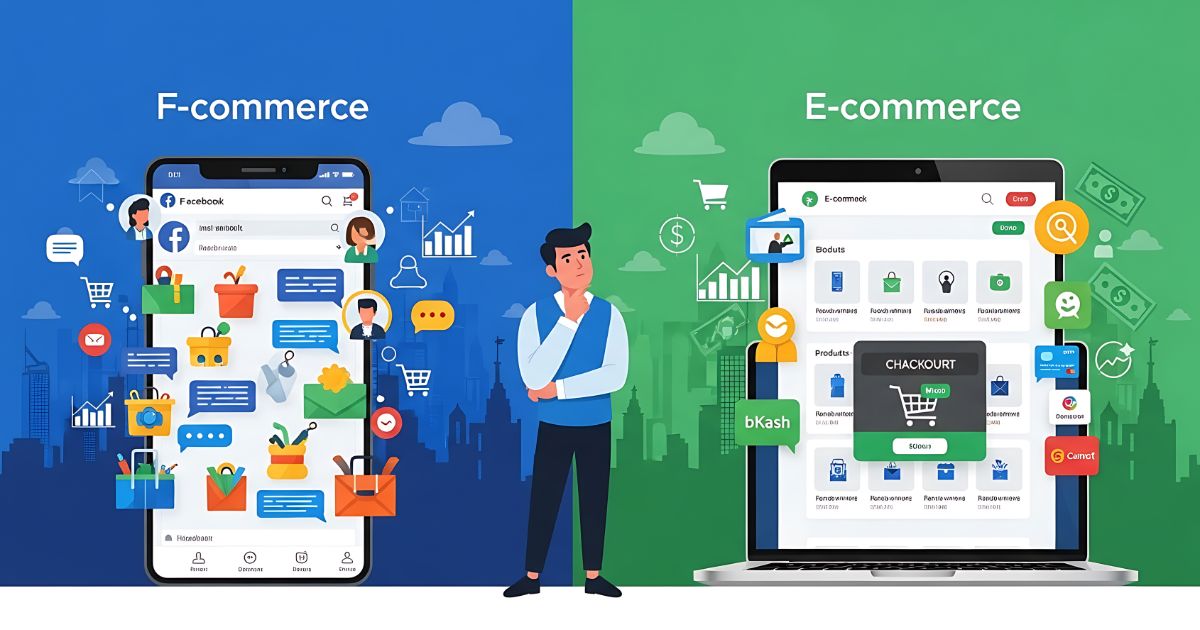
Many Bangladeshi businesses start their online journey with Facebook. It’s simple, familiar, and free to use. This is what people call F-commerce — selling directly through Facebook Pages, Groups, and Messenger. But as competition grows, business owners face an important question: Should I keep depending on Facebook, or is it time to build my own e-commerce website?
The choice matters. F-commerce offers easy access to customers but comes with limits in branding, control, and long-term growth. E-commerce, on the other hand, requires more setup and cost but provides stability, scalability, and a stronger brand presence.
This article compares both models with real examples from Bangladesh, highlighting where each works best and where it falls short.
What is F-commerce?
F-commerce refers to selling products and services directly through Facebook. In Bangladesh, this usually happens on Facebook Pages, Groups, Marketplace, and Messenger. Entrepreneurs upload photos, write descriptions, and take orders through comments or direct messages.
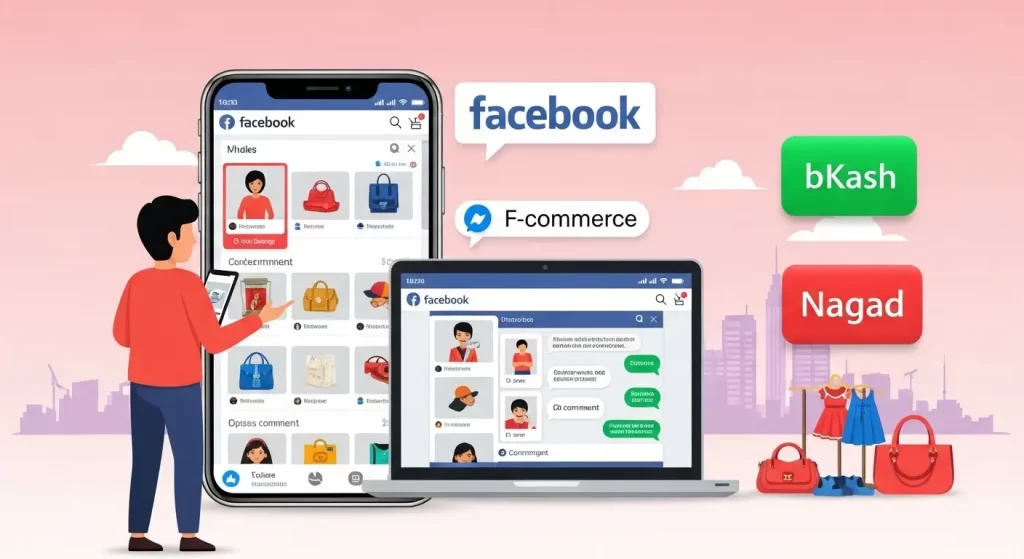
The model is popular because of Facebook’s massive reach in Bangladesh. According to DataReportal 2024, Bangladesh has over 52 million social media users, and Facebook is the most widely used platform in the country. For small businesses, this audience is an immediate customer base without the need for technical setup.
Another reason behind F-commerce growth is low entry cost. Opening a Facebook Page is free. Marketing is often done through organic posts or small-budget boosted ads. For example, many boutique clothing stores in Dhaka spend between 500 to 1,000 BDT per ad campaign, reaching thousands of local users. This creates a quick way to generate sales without investing in a full e-commerce system.
However, the process remains manual. Orders are usually confirmed through Messenger. Payments are handled via Cash on Delivery (COD) or mobile banking apps like bKash and Nagad. Inventory management, invoices, and shipping integration are almost always tracked manually, which makes scaling difficult.
F-commerce in Bangladesh gives small businesses a quick start. It is useful for testing ideas, launching products, or reaching a local community. The limits become clear once a business begins to grow beyond a small customer base.
What is E-commerce?
E-commerce is the process of selling products or services through a dedicated website or mobile application. F-commerce relies on Facebook. An e-commerce store gives businesses their own space, with full ownership and control.
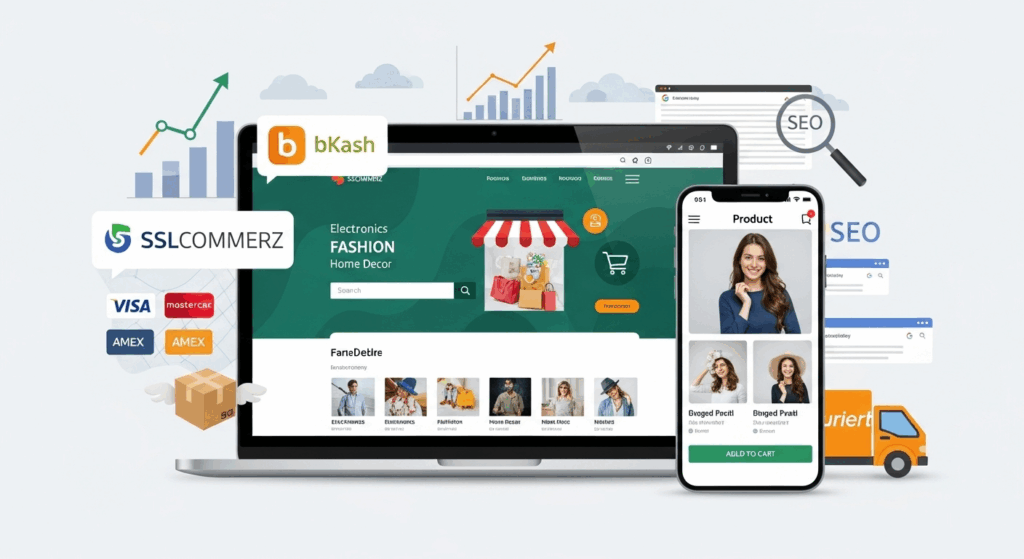
The sector is rapidly expanding in Bangladesh. According to the e-Commerce Association of Bangladesh (e-CAB) and industry reports, the country’s e-commerce market reached around 30,000 crore BDT in transaction volume in 2023, driven by increased internet usage and mobile financial services. Platforms such as Daraz, Chaldal, and AjkerDeal show how structured online stores can scale to millions of customers.
Setting up an e-commerce website requires investment in domain, hosting, design, and development. Businesses also need to integrate payment gateways like SSLCOMMERZ, bKash, or card systems, and connect with courier services for nationwide delivery. While this setup involves more cost than a free Facebook Page, it creates a structured sales system with automation and scalability.
E-commerce also offers long-term advantages in branding and visibility. A dedicated website can rank on Google through SEO, bringing in customers who search for products online. In Bangladesh, search engines are widely used before making purchase decisions, which means having a website not only drives sales but also builds credibility and trust.
E-commerce in Bangladesh is the foundation for businesses that want to grow beyond social media. It takes more planning and resources, but it builds sustainable growth in a competitive digital market.
E-commerce vs F-commerce: Head-to-Head Comparison
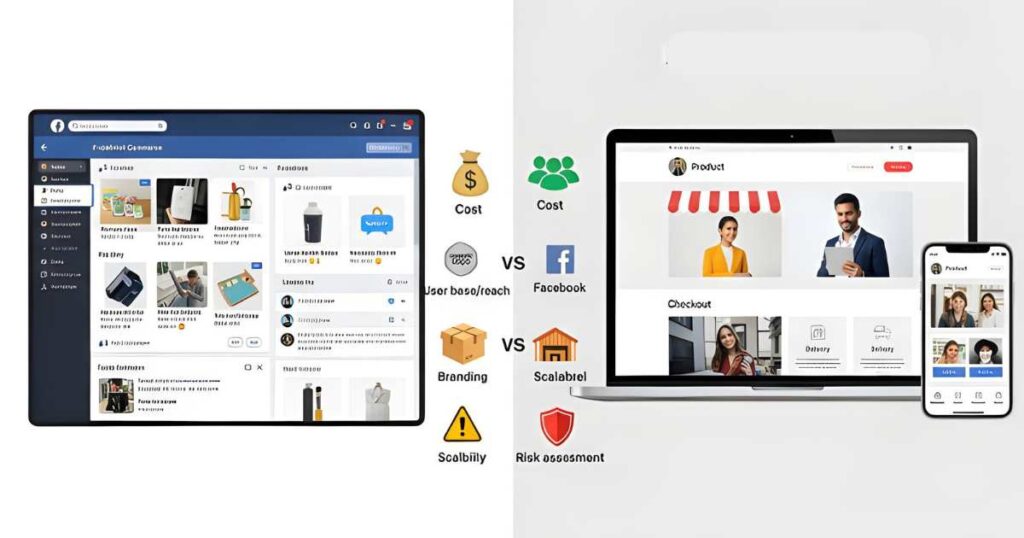
Business owners in Bangladesh often struggle to decide between staying on Facebook or moving to a dedicated website. The differences become clear when we look at the core factors side by side.
| Factor | F-commerce (Facebook-based) | E-commerce (Website-based) |
| Setup Cost | Free to open a page. Ads can start from 500 BDT per campaign. | Domain (1,000–1,500 BDT/year), hosting (3,000–10,000 BDT/year), development (20,000+ BDT one-time). |
| User Base | Access to over 52 million social media users, with Facebook as the most popular platform in Bangladesh (DataReportal 2024). | Reach through Google Search and direct visitors. Search engines are widely used by Bangladeshi buyers before making a purchase decision. |
| Branding | Limited to Facebook’s design. Looks informal. | Full control over design, branding, and customer experience. |
| Customer Experience | Manual order taking through Messenger. Payments mainly via COD or bKash. | Automated checkout, integrated payments, invoices, and order tracking. |
| Scalability | Works for small catalogs but difficult to manage large inventory. | Handles thousands of products with structured categories and analytics. |
| Risk | Dependence on Facebook. Accounts may get restricted or banned. | Full ownership of the website and data. Independent from third-party platforms. |
Key Insight: F-commerce is best for starting small and reaching customers quickly, but it lacks control and scalability. E-commerce requires investment, yet it builds long-term stability, brand trust, and room for growth.
Which is Best for Small Businesses in Bangladesh?
For small business owners in Bangladesh, the decision between F-commerce and e-commerce depends on customer behavior and growth goals.
Facebook dominates the online landscape. With over 52 million social media users in Bangladesh in 2024, it remains the easiest place to find potential buyers. This is why most small businesses begin with F-commerce. Customers are already used to browsing Facebook Pages, commenting on products, and placing orders through Messenger.
However, while Facebook is widely used, many Bangladeshi consumers are still cautious about online shopping. Studies show that a majority of buyers still prefer Cash on Delivery (COD) because they do not fully trust digital payments. Concerns about fraud, delayed deliveries, and poor product quality remain common. This is why F-commerce feels comfortable to many—it allows direct conversation with sellers before committing.
The situation is changing. The COVID-19 pandemic accelerated online shopping habits, and trust in e-commerce has continued to grow every year. Reports from e-CAB highlight steady increases in order volumes, especially in major cities like Dhaka and Chattogram. Mobile financial services such as bKash and Nagad also play a big role in making digital transactions easier. Younger customers, in particular, are more open to ordering directly from websites with integrated payment gateways.
This means F-commerce is a strong entry point, but it has a ceiling. Once a business gains steady sales and wants to scale, moving to e-commerce becomes the logical step. An independent website not only gives control but also helps build long-term trust with customers who are becoming more comfortable with structured online shopping.
Success Stories from Bangladesh
The shift from F-commerce to e-commerce is not just theory. Several well-known Bangladeshi brands show how moving beyond Facebook helps businesses scale.
Aarong is a clear example. The brand has a strong physical presence and an active Facebook community, but it also invested heavily in its e-commerce website. This allowed Aarong to serve customers across the country, offer online payments, and manage nationwide delivery through a structured system. During the pandemic, Aarong’s online sales grew significantly because customers could browse collections and order directly without relying only on Facebook messages.
Chaldal also shows the strength of dedicated e-commerce. It began as a grocery delivery startup with strong social media marketing, but its real growth came from a reliable website and mobile app where customers could order thousands of products with a few clicks. In 2024, Chaldal reported over $217 million in revenue and expanded beyond Dhaka into multiple cities. That kind of scale would be very hard to sustain through Facebook alone.
Another case is Daraz Bangladesh, now the country’s largest marketplace. Daraz uses Facebook for promotion but drives traffic to its e-commerce platform, where customers get a professional shopping experience, automated checkout, and regular discounts. Its success shows that while Facebook is important for marketing, the real sales system happens on the e-commerce side.
These examples prove a clear point: F-commerce helps small businesses get noticed, but long-term growth in Bangladesh happens when a brand builds its own e-commerce platform. It gives credibility, attracts search traffic from Google, and builds systems that can handle thousands of customers instead of dozens.
Actionable Steps for Bangladeshi Entrepreneurs
For many small business owners in Bangladesh, the biggest question is not whether e-commerce is better, but when is the right time to make the move. Here are clear signs and steps to guide the decision.
1. Know When to Upgrade
- If you receive more than 20–30 orders per week, managing everything through Messenger becomes difficult.
- If customers repeatedly ask for a website link, it shows they expect a more professional platform.
- If you want to reach new buyers beyond your Facebook followers, a website is the next step.
2. Estimate the Cost
Building an e-commerce website in Bangladesh is no longer out of reach.
- Domain and Hosting: Around 3,000–10,000 BDT per year, depending on the package.
- Website Development: A basic e-commerce site can start from 15,000–50,000 BDT. Advanced features may cost more.
- Payment Gateway Setup: Services like SSLCOMMERZ, bKash, or Nagad have low setup fees and charge per transaction.
This investment may feel high compared to free F-commerce, but the return comes from higher trust and automated systems that save time.
3. Plan the Timeline
A standard e-commerce site takes about 2–3 weeks to launch if requirements are clear. Agencies like Okriya focus on speed, offering complete setup within this timeline, including domain, hosting, design, and payment integration.
4. Prepare the Essentials
Before starting development, gather the basics:
- A clear business name and logo.
- High-quality product photos.
- Product descriptions with sizes, colors, and pricing.
- Preferred payment and delivery options.
5. Keep Facebook Active
Even after launching a website, do not abandon F-commerce. Use Facebook to drive traffic to your e-commerce store. Many successful brands in Bangladesh run ads and campaigns on Facebook, but direct customers to their websites for the final purchase.
Final Note
F-commerce has helped thousands of small businesses in Bangladesh sell online. It is simple, free, and backed by Facebook’s massive user base. For beginners, it remains the fastest way to test products and connect with early customers.
The limits become clear as a business grows. Building a brand, earning customer trust, and reaching buyers outside Facebook all require an e-commerce store. A dedicated website gives control over design, payments, and customer experience. It also builds long-term visibility on search engines, where more Bangladeshi buyers now begin their shopping journey.
The smartest approach is not choosing one over the other, but using both. Facebook works well for reach and traffic. E-commerce provides stability, credibility, and room for growth.
If you are ready to move forward, Okriya can help. We build professional e-commerce websites tailored for Bangladeshi businesses. From domain and hosting to design, payment integration, and delivery setup, everything is handled. Most projects launch in just two weeks, so you can focus on running your business.
Your business deserves more than a Facebook page. It deserves its own online store.
FAQs
What is the main difference between F-commerce and E-commerce in Bangladesh?
F-commerce runs entirely on Facebook Pages, Groups, and Messenger, while E-commerce uses a dedicated website or app. F-commerce is easy to start but limited in control and scalability. E-commerce requires more setup but gives full ownership, branding, and long-term growth potential.
Why do many Bangladeshi customers still prefer Cash on Delivery (COD)?
COD is popular because of low trust in online payments. Concerns about fraud, fake products, and delivery delays make customers feel safer paying at the door. However, mobile financial services like bKash and Nagad are increasing confidence in digital payments.
How much does it cost to run an E-commerce website in Bangladesh?
The cost depends on setup. A domain and hosting package can cost 3,000–10,000 BDT per year. Development starts from 15,000 BDT for a basic site and goes up for advanced features. Payment gateways such as SSLCOMMERZ or bKash usually charge per transaction.
What are the challenges of running F-commerce in Bangladesh?
F-commerce businesses depend entirely on Facebook. Problems include account restrictions, limited branding, manual order management, and difficulty scaling. Customers may also question credibility, as anyone can open a Facebook shop with little verification.
Can a business use both F-commerce and E-commerce together?
Yes. Many Bangladeshi businesses use a hybrid model: Facebook for reach and ads, while directing serious buyers to their website for checkout. This combines Facebook’s large audience with the control of a dedicated e-commerce store.
How do delivery and logistics work for E-commerce in Bangladesh?
Most e-commerce businesses partner with local couriers such as Pathao, RedX, Paperfly, Sundarban Courier. These services handle nationwide delivery and Cash on Delivery, making it easier for businesses to scale.
Which platform is better for long-term growth in Bangladesh?
F-commerce is good for starting small, but E-commerce is better for scaling. A dedicated website builds brand trust, enables SEO visibility, and supports thousands of products. In 2025, most serious businesses in Bangladesh are moving toward E-commerce.
Are there legal or compliance requirements for E-commerce in Bangladesh?
Yes. E-commerce businesses must comply with consumer protection laws, return policies, and government guidelines set by the Commerce Ministry and e-CAB. Displaying a privacy policy, terms of service, and clear return options increases trust.
Does E-commerce in Bangladesh really need SEO?
Yes. SEO helps websites rank on Google when buyers search for products. Facebook can generate quick sales through ads, but SEO builds long-term traffic at lower cost. In a competitive market, combining SEO plus Facebook ads works best.