

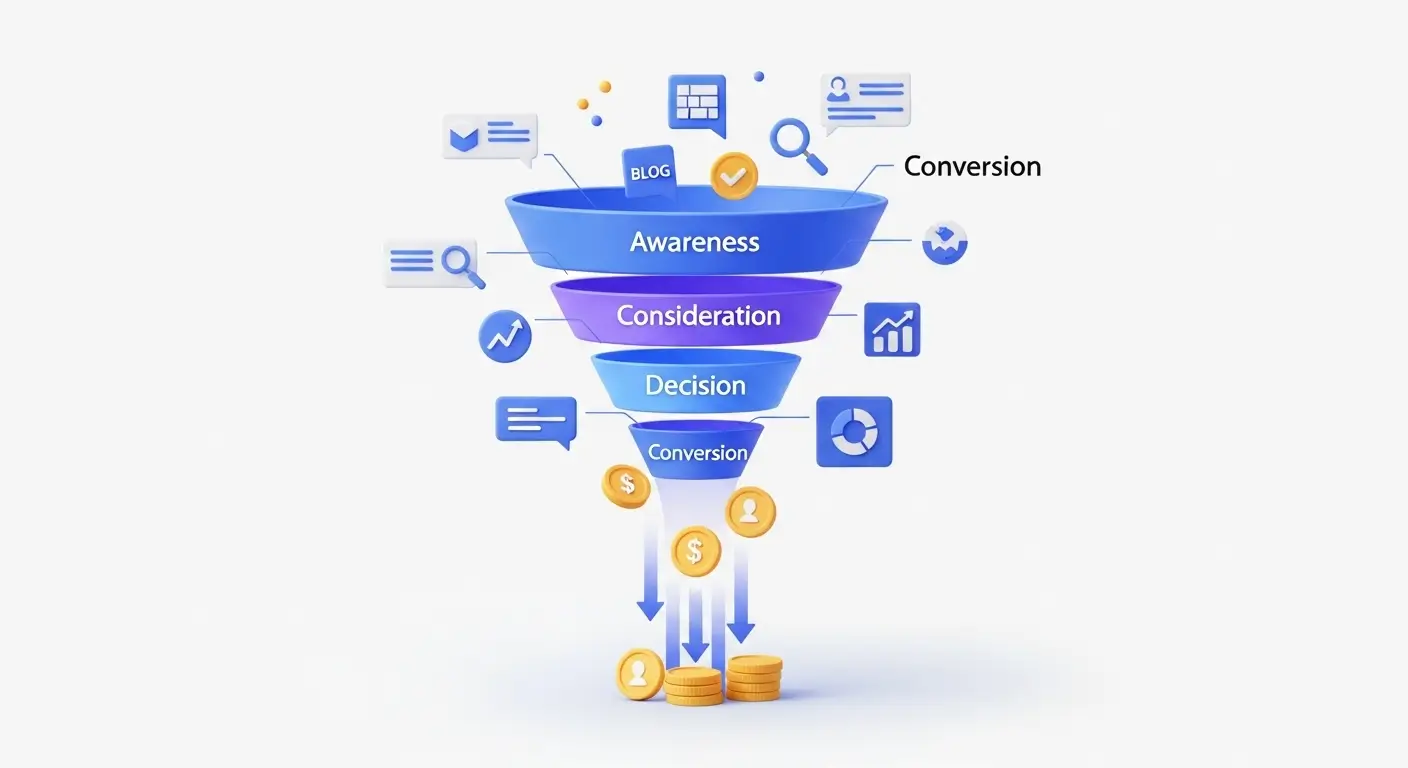
Content marketing turns curiosity into measurable action. A structured funnel supports your broader digital marketing strategy by building trust and converting website visits into qualified leads and sales.
Blog articles generate awareness, detailed guides build consideration, and landing pages capture conversions. When these assets connect, the funnel moves visitors from discovery to loyalty.
In this article, you will learn how to design that journey using content and see how strategy, structure, and value create a path that produces real business growth.
What Is a Content Sales Funnel?
A content sales funnel is a structured process that uses content to guide people from discovery to purchase. It connects marketing goals with customer behavior through a series of planned touchpoints.
Each piece of content serves a purpose: to attract, educate, convince, or convert. The funnel begins when a person first sees your brand and continues until they become a paying customer.
It links awareness, consideration, decision, and retention into one continuous journey. A well-built content funnel reduces friction in this journey and keeps users engaged.
It helps a business turn traffic into qualified leads and leads into revenue. In simple terms, it is a roadmap that turns attention into growth through meaningful content.
Core Stages of the Funnel (and What Each Needs)
A content sales funnel has four main stages. Each stage represents a different level of audience awareness and intent. Understanding what users need at each stage helps a brand create content that moves them closer to conversion. The four stages are awareness, consideration, decision, and retention.
Awareness Stage: Capturing Attention
This stage introduces your brand to new audiences. People here do not yet know your products or services. The goal is to create interest through helpful and educational content. Blog articles, social posts, infographics, and short videos work best at this level.
Content should answer common questions, solve simple problems, and show your brand’s expertise. Metrics such as impressions, clicks, and social engagement measure success.
Consideration Stage: Building Trust
At this stage, users start to compare solutions. They know what they want but are still learning which option fits their goals. The goal of content is to educate and build confidence in your brand.
Detailed guides, webinars, and case studies help explain benefits and show real results. Strong internal links and clear calls to action lead users toward deeper pages. Metrics such as downloads, time on page, and repeat visits show that trust is forming.
Decision Stage: Converting Interest Into Action
This stage focuses on turning leads into customers. Visitors are ready to take action but need a final reason to choose you. Content should be clear, persuasive, and focused on results.
Testimonials, client stories, service pages, and pricing information are effective here. Every element should remove doubt and make it easy to act. Key metrics include form submissions, sign-ups, and conversions.
Retention Stage: Turning Buyers Into Promoters
Once a customer converts, the goal shifts to retention. Content at this stage strengthens relationships and encourages loyalty. Email newsletters, product tutorials, and client success stories keep engagement high. Satisfied clients often share experiences and bring referrals. Tracking customer lifetime value and repeat interactions shows the strength of this final stage.
How Can You Build a Content-Driven Sales Funnel Step by Step?
Our marketing team builds a content funnel that links data, audience intent, and performance goals. Each stage uses structured content to attract visitors and convert them into customers. This alignment between behavior and objective creates measurable growth, improves engagement, and turns website traffic into consistent revenue.
Step 1: Define Buyer Personas
A buyer persona represents a segment of your audience defined by goals, challenges, and behaviors. Identifying personas helps align content topics with real customer needs.
Each persona should include demographic data, purchase motives, and preferred communication channels. This information allows you to produce content that speaks directly to intent.
Step 2: Map Content to Search Intent
Each piece of content must match a specific user intent: informational, comparative, or transactional. Professional SEO services in Bangladesh can help identify these search intentions and connect the right keywords with each stage of the funnel.
Decision content supports conversion. When content aligns with intent, the funnel moves efficiently and delivers higher engagement and stronger conversion rates.
Step 3: Audit Existing Assets
A content audit identifies what already exists and what gaps remain. It evaluates articles, videos, emails, and landing pages using metrics such as impressions, dwell time, and conversion rate.
The audit reveals which pages attract attention but fail to convert, guiding updates and new content production.
Step 4: Create Stage-Specific Content
Develop targeted assets for every stage. Educational blogs and social media posts attract awareness. Case studies and webinars nurture consideration.
Testimonials, pricing pages, and consultation offers convert interest into leads. Each asset must include a measurable goal, clear CTA, and structured internal links to keep users moving forward.
Step 5: Automate Nurturing Workflows
Automation connects marketing technology with behavioral data. Email sequences, retargeting ads, and segmented campaigns maintain engagement between visits.
Automation tools such as HubSpot, Active Campaign, or Mailchimp personalize delivery and timing based on user actions. Automation ensures consistent follow-up and lowers acquisition cost per lead.
Step 6: Measure and Optimize Performance
Every funnel must rely on analytics. Metrics such as click-through rate, session duration, and lead quality indicate effectiveness. Use Google Analytics, Search Console, and CRM dashboards to measure progress.
A/B testing validates which message or format converts better. Continuous monitoring turns data into decisions that increase conversion efficiency.
What Are the Best Tools and Metrics to Keep a Content Funnel Working?
A content funnel performs only when supported by accurate tools and measurable metrics. Each platform plays a defined role in tracking audience movement from awareness to conversion. The correct combination of analytics, automation, and reporting ensures that every content action produces business value.
Analytics and Tracking Tools
Google Analytics tracks traffic sources, session duration, and goal completions. Google Search Console monitors search visibility, keyword performance, and click-through rate. Heatmap tools such as Hotjar or Microsoft Clarity reveal how users interact with pages. Together these insights identify friction points, weak CTAs, and navigation errors that affect conversion.
Marketing Automation Tools
Automation platforms manage contact segmentation, lead nurturing, and performance reporting. HubSpot, Active Campaign, and Mailchimp deliver personalized sequences based on behavior data. Automated follow-ups maintain engagement between sessions and reduce lead drop-off. Integration with CRM software connects marketing insights to actual sales outcomes.
Content Planning and SEO Tools
SEMrush, Ahrefs, and Surfer SEO analyze keyword intent, backlink quality, and topic authority. These tools guide content updates by showing which pages need optimization or expansion. A well-defined keyword map based on these insights improves visibility across all funnel stages.
Key Metrics for Each Funnel Stage
At the awareness stage, impressions, reach, and organic clicks measure visibility. At the consideration stage, engagement rate, session depth, and email sign-ups measure audience interest. At the decision stage, form submissions, quote requests, and conversion rate show purchase intent. At the retention stage, repeat visits, customer lifetime value, and referral rate indicate brand loyalty.
Performance Review and Continuous Improvement
Metrics without interpretation provide no strategic benefit. Regular review cycles align performance data with business goals. Quarterly audits, funnel reports, and A/B testing sessions identify weak links and new opportunities. Every adjustment based on data improves conversion speed, lead quality, and marketing efficiency.
What Are Common Content Funnel Mistakes and How to Fix Them?
Even a strong content funnel can fail if key principles are ignored. Each mistake increases the distance between audience intent and conversion. Identifying these issues early helps a brand maintain performance and protect marketing investment.
Publishing Without Strategic Intent
Many teams create content without linking it to a clear funnel goal. Articles may attract traffic but fail to guide readers toward conversion. A strategic funnel assigns a purpose to every asset, ensuring alignment between content topic, user intent, and measurable outcomes. Each piece should answer a question, remove doubt, or direct users to the next stage.
Ignoring Middle-Funnel Engagement
Most businesses invest heavily in awareness campaigns but neglect the consideration stage. Without nurturing content, potential leads lose interest before making a decision.
Case studies, webinars, and comparison guides keep audiences engaged during this stage. Measuring engagement depth and repeat visits confirms whether users are moving forward in the funnel.
Weak or Misaligned Calls to Action
A call to action functions as the conversion trigger. Vague or misplaced CTAs confuse users and lower conversion rate. Each CTA must be visible, specific, and relevant to the user’s stage in the funnel. Phrases such as “Get a Free Audit” or “Book a Strategy Call” guide users toward measurable actions that benefit both sides.
Neglecting Data Validation
A funnel that operates without verified data cannot improve. Businesses often collect metrics but fail to analyze or cross-check them. Validating data sources ensures accuracy in reporting and decision-making. Tools such as Google Data Studio or HubSpot dashboards unify data streams and highlight actionable insights.
Measuring Vanity Metrics Instead of Business Outcomes
High traffic numbers may appear successful but do not confirm profitability. Metrics such as click-through rate and bounce rate support analysis, yet the final goal remains revenue. Tracking customer acquisition cost, lead-to-sale ratio, and lifetime value connects marketing data to financial performance.
Failing to Update and Optimize Content
Content performance changes as algorithms and audience behavior evolve. Ignoring updates reduces visibility and trust. Regular content refreshes maintain accuracy, relevance, and SEO authority. Reviewing keyword intent, backlink quality, and conversion flow every quarter keeps the funnel efficient and adaptive.
Applying the Funnel Mindset to Our Agency Growth
At Okriya, we grow by using the same funnel strategy we design for our clients. We create awareness through blogs, videos, and insights that show our expertise in content strategy and digital marketing. We build consideration by sharing case studies and performance data that prove how our process delivers measurable results.
We strengthen decisions with testimonials, transparent pricing, and a portfolio that highlights real business impact. We focus on retention by keeping strong client relationships and improving performance with every campaign. Each stage gives us data that shapes smarter marketing actions.
Our internal funnel keeps our sales, marketing, and service teams aligned around one goal: consistent client success. We believe every brand deserves a growth system that works this effectively.
Explore our digital marketing and conversion optimization services to build your own funnel that turns attention into revenue.
Frequently Asked Questions
1. What are the main attributes of an effective content sales funnel?
An effective content sales funnel includes clear stages, measurable goals, and aligned content formats. The core attributes are audience segmentation, keyword targeting, automation workflow, and conversion tracking. Each attribute connects to performance data, allowing marketers to predict outcomes and adjust strategy.
2. How does content quality influence funnel conversion rate?
High-quality content increases dwell time, engagement, and brand trust. Search engines evaluate depth, factual accuracy, and topical completeness as indicators of authority. When content answers questions precisely and includes verified data, conversion probability increases because users recognize relevance and reliability.
3. Which metrics show if a content funnel works correctly?
Key metrics include traffic growth for awareness, engagement rate for consideration, form completion for decision, and retention rate for loyalty. Additional attributes such as session duration, cost per lead, and lifetime value reveal how each funnel stage contributes to revenue.
4. How do automation tools support the content funnel?
Automation tools such as HubSpot, Active Campaign, and Mailchimp deliver content to segmented audiences at optimized times. These tools manage workflows, lead scoring, and behavior-based follow-ups. Each automation attribute, like trigger events or segmentation rules, reduces response time and increases conversion consistency.
5. What role does keyword intent play in funnel success?
Keyword intent defines the connection between user behavior and content goal. Informational keywords attract discovery traffic. Commercial keywords target comparison searches. Transactional keywords lead users to conversion pages. Aligning content with intent attributes ensures that each query receives the right answer at the right stage.
6. How often should a team audit its content funnel?
Teams should audit quarterly or after major algorithm updates. Each audit checks data accuracy, keyword performance, and content freshness. The process validates technical SEO attributes, internal link structure, and CTA clarity. Regular audits maintain semantic alignment with evolving search behavior.
7. What human roles keep a funnel performing well?
A strategist defines the structure, a writer produces content aligned with entities, a designer ensures visual flow, and an analyst measures performance. Collaboration among these roles keeps funnel attributes balanced between creativity, usability, and data accuracy.
8. How does user experience connect with conversion rate?
A clear interface, readable layout, and fast loading time reduce friction between interest and action. UX attributes such as visual hierarchy, button placement, and mobile responsiveness directly influence conversion probability. Search systems treat strong UX as a positive quality signal.
9. How can an agency prove funnel ROI to clients?
An agency measures return on investment using combined marketing and CRM data. Key attributes include cost per acquisition, revenue per campaign, and retention duration. When reports connect these values to content actions, clients see measurable proof of funnel efficiency.
10. What future trends will improve content funnel performance?
AI-driven personalization, predictive analytics, and automated content clustering will redefine funnel optimization. These technologies connect behavioral data to dynamic content delivery. Agencies that integrate machine learning attributes into analytics and automation will achieve faster adaptation and higher conversion stability.