

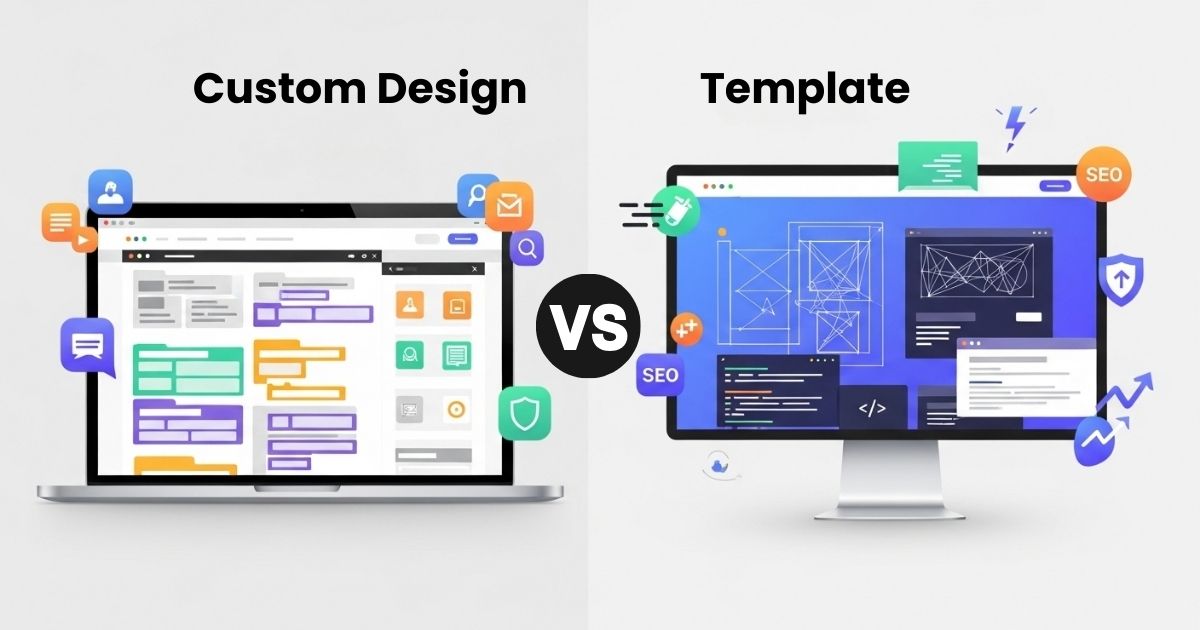
A website is the starting point for any business online. It shapes first impressions, builds credibility, and gives customers the information they need. Before creating one, you must choose how it will be built: with a ready-made template or a custom design.
Template websites are fast and affordable to launch. Custom websites are tailored for branding, performance, and growth. Both have clear benefits and limits. The right choice depends on your goals, budget, and long-term plans.
This guide explains what each option means, highlights their pros and cons, and shows how to decide which approach is best for your business.
What Is a Template Website?
Template websites are built with pre-designed layouts. These layouts already include pages, styles, and basic functions. Instead of creating every element from scratch, you select a theme and update it with your own text, images, and colors. It makes templates a quick and practical choice for businesses that need an online presence without heavy design or development costs.
Platforms such as WordPress, Wix, Squarespace, Shopify, and Webflow provide free and paid themes. They often include tools like drag-and-drop editors, contact forms, galleries, and plugin support. Most themes are designed to cover standard needs such as homepages, product catalogs, blogs, and service pages.
Many small businesses, freelancers, and startups use templates to get online fast. A local store may use one to display products. A personal brand can present work with little expense. Community groups also rely on them when testing ideas or running short-term projects before moving to a custom build.
Pros of Template Websites
- Fast setup: Templates allow a site to go live within days or weeks because the design and structure are already prepared.
- Lower upfront cost: Ready-made themes are more affordable than custom builds, which makes them practical for businesses with limited budgets.
- Ease of use: Platforms such as Wix, Squarespace, and Shopify provide drag-and-drop builders, so even non-technical users can manage a site.
- Responsive design: Most modern templates are mobile-ready, helping the website display properly on smartphones, tablets, and desktops from the start.
Cons of Template Websites
- Generic appearance: Many companies use the same themes, which reduces uniqueness and weakens brand identity.
- Limited customization: Pre-built layouts restrict how much the design or functionality can change, which creates problems when a business needs to grow.
- Performance issues: Extra scripts, plugins, and unused features in templates often slow down page speed and reduce SEO performance.
- Security risks: Widely used themes and plugins are frequent targets for hackers, especially if updates are ignored.
- Restricted support: Once code is customized, many template providers stop offering help, forcing businesses to hire external developers.
What Is a Custom Website Design?
Custom website design is built specifically for one business. The layout, code, and features are planned from the ground up. Each element is designed to match brand identity, meet functional needs, and support long-term goals. Nothing comes from a pre-made theme. This gives complete control over how the site looks and works.
These websites are created by professional designers and developers. Many are built with frameworks and platforms such as WordPress using custom themes, Laravel, or React for complex applications. This approach allows teams to focus on design quality, performance, and user experience.
Custom design is often chosen by growing companies, e-commerce brands, and service providers that need advanced features and strong SEO foundations. Startups in competitive industries also turn to custom builds to create a unique online presence and scale without limitations.
Pros of Custom Websites
- Unique identity: The design is tailored to match brand style, messaging, and audience needs.
- Stronger SEO foundation: Developers can build a clean structure with fast loading speed and optimized code for search engines.
- Scalability: New features and integrations can be added as the business grows without rebuilding the entire site.
- Improved performance: Custom builds are optimized for speed, responsiveness, and accessibility.
- Security control: Specific security features can be implemented to reduce risks and protect data.
- Professional support: Ongoing help is usually available from the agency or development team that created the site.
Cons of Custom Websites
- Higher cost: Building from the ground up takes more time and requires professional expertise, which raises the upfront investment.
- Longer launch timeline: Design, development, and testing can take several weeks or months.
- Skilled resources needed: Businesses must rely on experienced professionals for coding, design, and maintenance.
Custom vs Template Websites: A Side-by-Side Comparison
The main differences between template websites and custom websites become clear when they are compared across cost, time, design, SEO, and growth potential. The table below highlights the most important factors.
| Factor | Template Website | Custom Website |
| Cost | Lower upfront cost, but extra plugins, updates, and redesigns add expenses later | Higher upfront investment, but fewer limitations and better long-term return |
| Launch Time | Ready in days or weeks using pre-built layouts | Requires weeks or months due to full design, coding, and testing |
| Design | Pre-made themes with limited flexibility | Tailored design that fits brand identity and business goals |
| SEO | Often slowed by extra code and plugin reliance | Built with clean code, faster speed, and full SEO optimization |
| Scalability | Hard to expand beyond basic functions | Flexible, supports new features and integrations as business grows |
| Performance | May suffer from heavy scripts and limited optimization | Optimized for fast loading, responsive design, and accessibility |
| Security | Relies on third-party updates, higher risk of vulnerabilities | Custom security features can be implemented based on business needs |
| Support | Limited help from template providers, especially after custom edits | Professional support available from the design and development team |
This comparison shows that templates are suitable for quick, low-budget projects, while custom websites provide more control, stronger performance, and better scalability.
Cost Breakdown: Template vs Custom
Budget often shapes the choice between a template website and a custom website. Both options carry upfront and ongoing expenses that influence long-term value.
Template Website Costs
- Themes range from free to a few hundred dollars. Premium options on WordPress, Shopify, or Squarespace usually cost between $50 and $300.
- Hosting, domain registration, and premium plugins add recurring expenses each year.
- Extra customization or troubleshooting may require a developer, which increases the overall spend.
- Over time, many businesses outgrow a template and invest in a redesign, which raises total ownership costs.
Custom Website Costs
- Custom builds often start at a few thousand dollars. The final price depends on design complexity, features, and integrations.
- Upfront expenses cover planning, design, coding, and testing.
- Long-term costs are usually lower since the site is built to scale, avoids repeated rebuilds, and performs more efficiently.
- Maintenance and updates are commonly included in service agreements, keeping the site secure and reliable.
Templates look affordable in the beginning, but costs increase as business needs expand. Custom websites require more investment at launch, yet they deliver stronger value for companies that want flexibility, performance, and long-term growth.
SEO and Performance Considerations
Search visibility and site performance are two of the strongest factors in attracting and keeping visitors. How a website is built has a direct impact on both.
Template Websites
Most templates include pre-installed scripts, plugins, and design elements that are not always needed. Extra code slows down loading speed, which hurts both user experience and rankings. Google studies show that users expect a page to load in about two seconds, and slower sites often see higher bounce rates.
Templates also provide limited control over technical SEO features such as schema markup, structured URLs, or optimized metadata. Mobile-first indexing is another challenge, since not all themes are fully optimized for smartphones.
Frequent updates from third-party developers are required to patch security issues and maintain performance, but these updates can sometimes create conflicts with the theme.
Custom Websites
Custom builds give developers complete control over structure, design, and code. Every part of the site can be optimized for Core Web Vitals, which measure loading speed, interactivity, and visual stability. Clean coding improves responsiveness and helps the site perform well on both desktop and mobile devices.
SEO best practices such as heading structure, schema markup, and internal linking can be applied during development. Because the site is tailored to business needs, it avoids unnecessary features and maintains long-term efficiency.
Templates often struggle to meet modern SEO and performance standards. Custom websites are designed to support fast load times, mobile optimization, and scalable SEO growth.
Which Is Better for Your Business: a Template Website or a Custom Website?
The right choice depends on what your business needs today and how it plans to grow tomorrow. A template website is often the better option when speed and budget are the main concerns.
It can be launched within days, costs less upfront, and covers basic requirements like a homepage, contact form, or product catalog. Templates also make sense for short-term or experimental projects, such as a campaign landing page, a personal portfolio, or a community site.
A custom website becomes the stronger choice when long-term goals, branding, and growth are priorities. Companies that rely on SEO and online visibility to bring in leads benefit from clean coding and tailored optimization.
Businesses with larger plans, such as adding e-commerce, membership systems, or advanced integrations, often need the scalability of a custom build.
Security and performance are also major reasons to invest in custom development, especially for organizations that handle customer data or operate in competitive industries.
In simple terms, templates work well for small or temporary projects that must go live quickly. Custom websites deliver more value for companies that want to stand out, scale, and build a strong digital presence over time.
FAQs
Can I start with a template website and upgrade it to custom later?
Yes. Many businesses begin with a template for speed and cost reasons, then move to a custom build once they grow. Migration usually requires rebuilding the design but existing content can be transferred.
Do custom websites always require a large team?
Not always. Small projects may only need a designer and a developer, while larger builds may involve SEO specialists, UI/UX experts, and testers. The size of the team depends on project complexity.
How do templates handle website accessibility?
Some modern templates are built with accessibility in mind, but many fall short. Custom websites can be designed to meet accessibility standards such as WCAG, making them more user-friendly for people with disabilities.
Is it possible to combine a template with custom development?
Yes. A template can be customized with extra coding, plugins, or integrations. However, heavy modifications may reduce performance or break theme updates, which is why many businesses eventually shift to a full custom build.
How often should a website be redesigned?
Most websites benefit from a redesign every 3–5 years to stay current with design trends, technology standards, and user expectations. Templates may need updates sooner if they become outdated or unsupported.
Are there industries where custom websites are strongly recommended?
Yes. Businesses in competitive sectors such as e-commerce, SaaS, healthcare, finance, and education often need custom solutions for branding, compliance, and scalability.
What are the risks of relying too heavily on plugins with a template site?
Too many plugins can slow down performance, create conflicts, and increase security risks. A custom build avoids this issue by coding features directly into the site.